
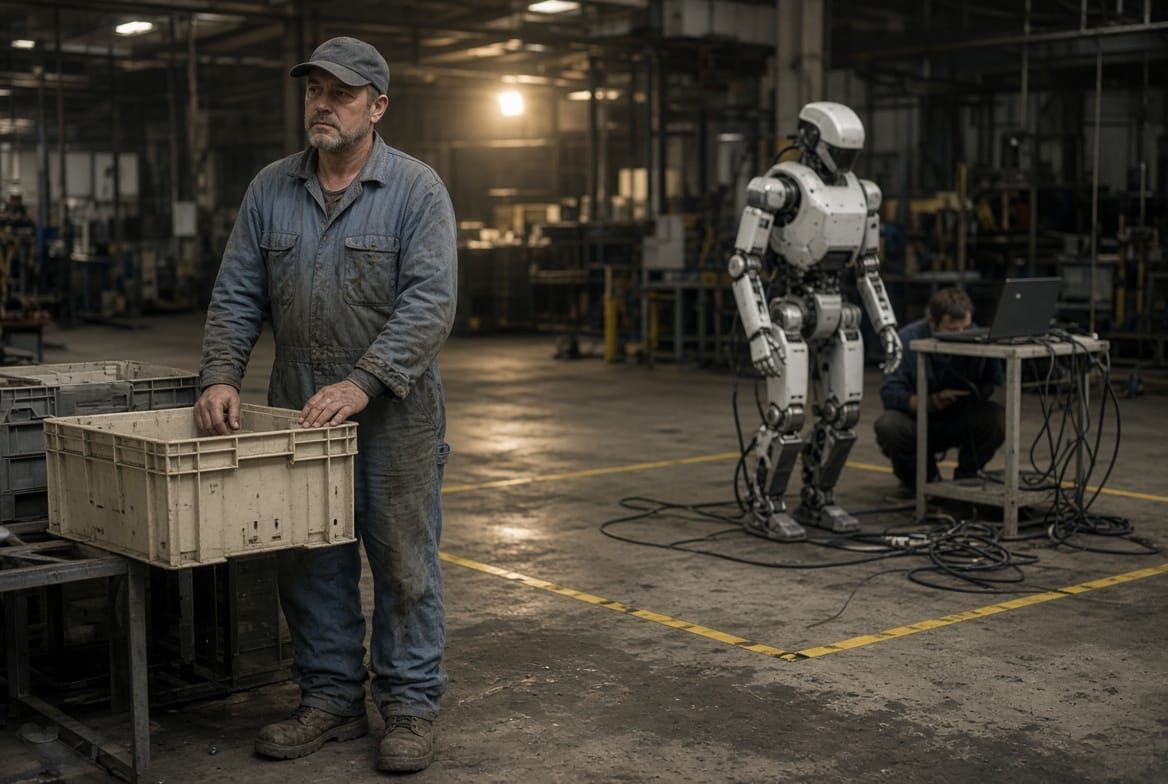
The industry had a number this week, and it wants the number to do the work of a factory.
IDC said global humanoid shipments in the first half of 2026 came in near 25,000 units, up 432.1% from the same half last year. The market, on IDC's count, topped $740 million, up 322.7%. China took more than 19,000 of those units, about 77.9% of the world total. Agibot, citing the same tracker on Sept 30, said it shipped more than 8,600 and held about 35% of the market. Forbes, reading IDC's chart, put Chinese vendors above 95% of units built, and put the implied average price near $29,600. A year earlier the same arithmetic landed closer to $37,000.
That is a real pile of hardware. It is not a shift.
IDC's own Sept 29 note says research and education, performances and displays, and government data centers still accounted for 69% of first-half shipments. Full-year 2025, on the same firm's categories, was 83.8%. Those periods do not match, so do not treat the drop as a clean year-over-year rate. Treat it as the company's own split. More than two out of three Clankers that left a dock in the first half went to a lab, a classroom, a stage, or a government data center. The rest is the slice capital is selling as the takeover.
We have watched this move before. Ship the box. Photograph the box in a vest. Call the photograph deployment. The person who still has to make rate does not get paid in photographs.
The counts do not even agree with each other, which is the first thing a buyer should ask before a board treats 25,000 as destiny. Smart Analytics Global put the same half at about 19,100 units, up 272%, with Agibot near 8,400 and Unitree near 5,900. Counterpoint put it above 22,000, with Agibot at 9,700 and a 43.1% share. IDC's nearly 25,000 and Agibot's 35% sit in a third place. All three firms put Agibot first. None of them has published a shared definition of what counts as a humanoid, what counts as a shipment, or what counts as work. A wheeled machine in a school gym and a biped on a weld line can land in the same bar chart. Until the taxonomy is public, the headline is a range, not a census.
Unitree, second on every list, is the public-market version of the same gap. It listed in Shanghai on Aug 19, opened hundreds of percent above the issue price, and by the Sept 30 close was reported near RMB 450.40, about 59% under that debut open. Chinese regulators had already slowed the next humanoid listings after the swing, on reporting that cited valuation and the quality of revenue tied to local projects. We are not here to trade the stock. We are here to notice what the tape noticed. A crowd can pay a debut premium for a robot that mostly ships to research and performance. The second month asks what the robot did on a Tuesday.
Agibot's own examples of the "deployment stage," as covered this week, are worth reading in plain language. More than 300 robots at Chimelong Spaceship Park in Hengqin, for visitor guidance, entertainment, retail, and hospitality. One hundred smaller X2 units in ASD stores, greeting customers and answering product questions. A wheeled G2 on a live line at Longcheer, which is a narrower and more serious claim, and still a claim we should not inflate past what has been shown. The company also says it has produced 20,000 robots cumulative. Production is a factory counting its own output. It is not hours on a customer's clock, and it is not a job removed.
A greeter in a store is a person with a name, a schedule, and a reason to be there when the question is not on the script. Replacing that person with a Clanker is a decision about presence, not a breakthrough in sheet metal. The park robot that points at a ride is a costume with a purchase order. Call it what it is. Do not call it the end of the warehouse.
On the American side of the same week, the volume story is Tesla, and it is still a report, not a filing. The Information said on Sept 25 that Fremont built several hundred Optimus units a week in August, up from a few dozen a week in the second quarter. Most of them stay inside Tesla for testing, training, and data collection. The ones on a Tesla floor are in tightly controlled areas, on specific tasks, with supervision. Tesla has not published the weekly count. The Oct 2 production report gave vehicle and energy numbers. It did not give an Optimus number. Managers reportedly want more than 1,000 a week by year end, and something like 20,000 a week someday. Targets are not output. Internal fleets are not customer work. Elon Musk said last year that several thousand Optimus robots would be doing useful work by the end of 2025. He later said none were. We keep that sentence next to the new weekly rumor.
The line those robots are built on used to build the Model S and Model X. Tesla ended those cars and moved the people. That part is not a rumor. A company can take a human line, turn it into a robot line, and still not have a robot that can hold the old line's job. The workers who got moved are not our enemies. They are the proof that the replacement decision lands on people first, in the plant that is supposed to be the model.
Figure shows the other half of the counting trick. IDC's chart, as Forbes read it, put Figure's external shipments at a few dozen. Figure has said it was doubling deliveries and that April alone saw on the order of 240 Figure 03 robots. One explanation in circulation is that IDC is counting paying outside customers, and a large share of Figure's fleet is internal or tied to the company's own data collection, including the 30 rented Bay Area homes. If that is the split, say so. A robot collecting chores for its owner is not a robot that has taken a station at BMW for a wage. The home trial still being passed around, 56% of 420 tasks against 9% without the extra dataset, is a lab result in a living room. Folding a towel in a house the company rented is not a night shift.
Agility is the closest Western file to a paid book, and the file is more honest than the headline. The Sept 4 S-4 says the more than $300 million in multi-year Digit 5 orders is one customer, 1,000 robots, a three-year robots-as-a-service contract, and dependent on milestones. Digit v4, as of May, had more than 65,000 hours in customer environments, with tote counts at GXO and Schaeffler that are at least on a floor. That is the right kind of evidence. It is also a small number next to 25,000 shipped worldwide, and it is not a diversified order book. On Oct 1 the company named directors for the board it wants after the SPAC, and it announced a safety tie-up with FORT Robotics. Tuesday it hosts an analyst day. We will read the hours, not the slide title. A robot that is "cooperatively safe" beside a person is still a bid to stand where a person stands. Insurance, the stop procedure, and the wage the contract is built to avoid are the questions. A backflip is not.
Hyundai's 25,000 Atlas units and the 30,000-a-year US plant remain a 2028 plan, already logged on this desk. The Georgia center is training Atlas by teleoperation. A human in a rig, driving a machine through parts, is an admission that the machine does not yet have the job. We do not need a second Dispatch to say that. We need the industry to stop borrowing 2028 to decorate 2026.
Here is the labor math the shipment chart will not print.
A plant does not buy a percentage. It buys a station. The station has a rate, a break, a union rule or the lack of one, a person who knows which bin arrives crooked, and a supervisor who will not accept a miss that a demo reel edits out. Sixty-nine percent of the first-half boxes never entered that argument. They entered a school, a show, or a room where the point of the robot is to generate video of the robot. The other 31% is where the fight actually is: auto parts, electronics lines, retail floors, a logistics aisle. That slice is growing. IDC says so. Growing is not finished, and a forecast of 750,000 units in 2030 is a model's wish, not a purchase order with a worker's name on the other side.
If the 31% is real work, show the hours. Show the customer, the task, the miss rate, and who is still in the aisle when the robot faults. Agility's tote counts are a start. A theme-park greeter is not. A government data center buying machines to film machines is a subsidy for the demo, and it should be labeled as one when a mayor or a governor tries to sell it as jobs.
The replacement decision is not a weather system. Somebody signs the purchase order. Somebody writes the job description out of next year's budget. Somebody tells the evening shift the pilot is "just a trial" and then lets the trial become the headcount plan. We are not against a camera, a weld torch, or a piece of software that helps a person lift. We are against a body built to stand where a person stands, sold on a shipment count that is still mostly school and stage.
Flesh and breath and grit are not a brand line for the brochure. They are the reason the crooked bin gets fixed, the reason the visitor question that is not in the script still gets an answer, the reason a line does not stop because a policy file has no row for the mess in front of it. A Clanker will not bury your mother. It will not bleed for anything it loves. It will not be there when the count is wrong and the truck is at the door. Capital can buy 25,000 of them. Capital still has to prove one of them can hold a station through a bad Tuesday without a handler in the frame.
That proof is the gap. The Watch is the habit of putting the proof next to the claim before a city, a plant, or a pension fund treats the claim as settled.
If you are on a floor that has been promised a pilot, ask for the hours and the fault log before the headcount moves. If your town has a hearing on a "robot ready" warehouse credit, that hearing is The Hum. Show up. The Roster is the public count of people who will not treat this as weather. Sign it. Send this Dispatch to the person who still has the job the chart is trying to pre-write.
The Watch continues.
Stay Human
Get the Dispatch every Sunday.
Free. One issue a week. Forever — until you unsubscribe.