
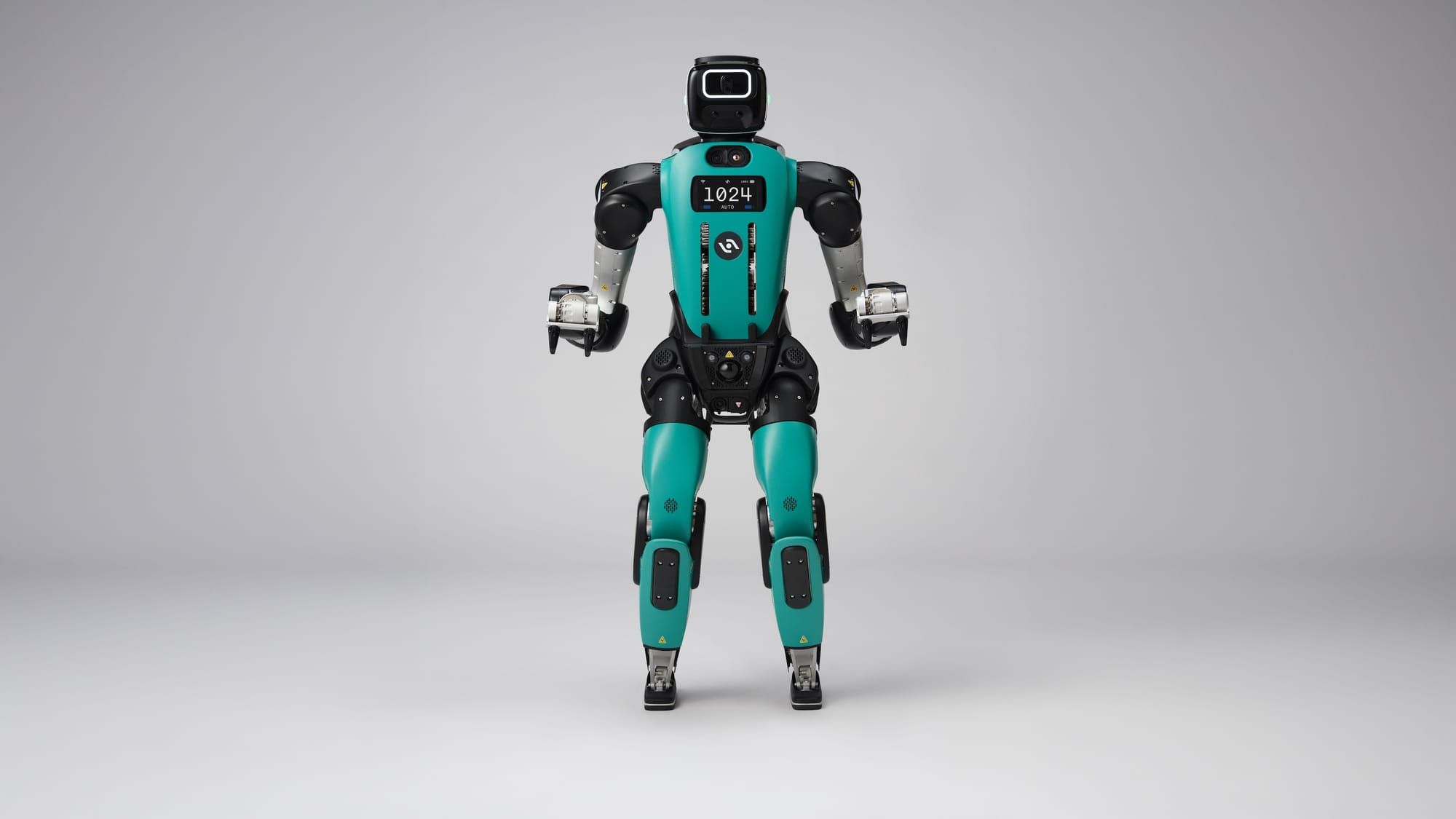
Agility Robotics put Digit 5 in front of the press this week. The company says the new humanoid can work next to people with no physical barriers. It can lift 50 pounds repeatedly. The battery supports long shifts. Hands swap for different tools. Early access is scheduled for the first half of 2027.
The announcement comes with more than $300 million in multi-year orders for Digit 5. Agility says prior Digit units have already logged more than 65,000 hours across nine customer facilities. Named sites include Schaeffler, GXO Logistics, and Toyota Motor Manufacturing Canada. The company is preparing to go public through a $2.5 billion SPAC.
Capital is buying the story that the cage can come down and a humanoid can share the floor.
The filings are narrower. The $300 million figure, measured as of May 2026, is a single three-year robot-as-a-service contract for 1,000 Digit 5 units. The counterparty is a related party. The value depends on contractual milestones and on product features that still have to match the spec. It is not current-period revenue. Warrants vest as robots are deployed. Agility is still evaluating the accounting treatment.
In 2025 the company recorded $1.78 million in net sales against an operating loss of roughly $140 million. Gross results were negative. The auditor included a going-concern note. Those are the public numbers under the order claim.
Digit 4 worked behind barriers or in defined cells. Digit 5 is sold as the machine that ends that constraint. Sensors and AI are supposed to detect nearby people and stop or sit when they have to. NVIDIA's Halos safety stack is named as a partner. Once physical separation ends, the pitch is that humanoids can use the same aisles and loading zones people already walk every shift.
A robot stacking a tote in a cell is not the issue. The issue is whether a machine in human shape belongs on the same floor as the people who already work there, and on what terms.
Warehouse and factory work still runs on human labor for tasks that change daily, need judgment at contact, or have not been engineered into fixed automation. Labor shortages are real in some sites. Turnover is high. Capital is not answering that only with more fixed automation. It is answering with a bipedal machine meant to occupy the same space and absorb the same motions.
Agility's own illustrative economics show the pressure. Under a robot-as-a-service model near $8,500 per month, the machine has to displace a meaningful number of human hours every day to clear the cost. Ownership models put total five-year cost near $400,000 per unit once deployment and maintenance are included. The numbers only work if the robot stays productive and the human shifts it replaces stay gone.
We have seen this pattern. A hard commercial number gets announced. The fine print shows one contract, conditions attached, and a related-party counterparty. Prior operating hours exist, but the leap to barrier-free scale is still ahead. Early access is next year, with general availability later than that. The gap between the press claim and verified readiness is in the S-4 itself.
The gap matters because the form factor is the point. A fixed arm stays in its cell. A wheeled AMR stays on its path. A humanoid is built to walk the same floors and handle the same objects people handle. When the safety case is accepted and the barriers come down, replacement moves from specialized stations into the open facility.
Fixed automation and specialized machines have their place. What is being sold here is the choice to put machines in human shape into human workspaces, and to treat the end of separation as progress instead of a political and economic decision that can be contested.
Workers on those floors still show up with bodies that tire and families that need wages. Their skills are not yet coded into the model. The filings do not erase that. They price the machine meant to stand in the same place.
We do not accept the frame that this is inevitable. Capital is choosing the form factor and the timeline. Filings, order structures, and loss numbers remain public. The Watch records them.
Sign the Roster if you refuse quiet acceptance of humanoid form-factor replacement of human presence and work. Check The Hum for local decisions that affect floors near you. Read the next Dispatch when it lands.
Stay Human.
Get the Dispatch every Sunday.
Free. One issue a week. Forever — until you unsubscribe.