
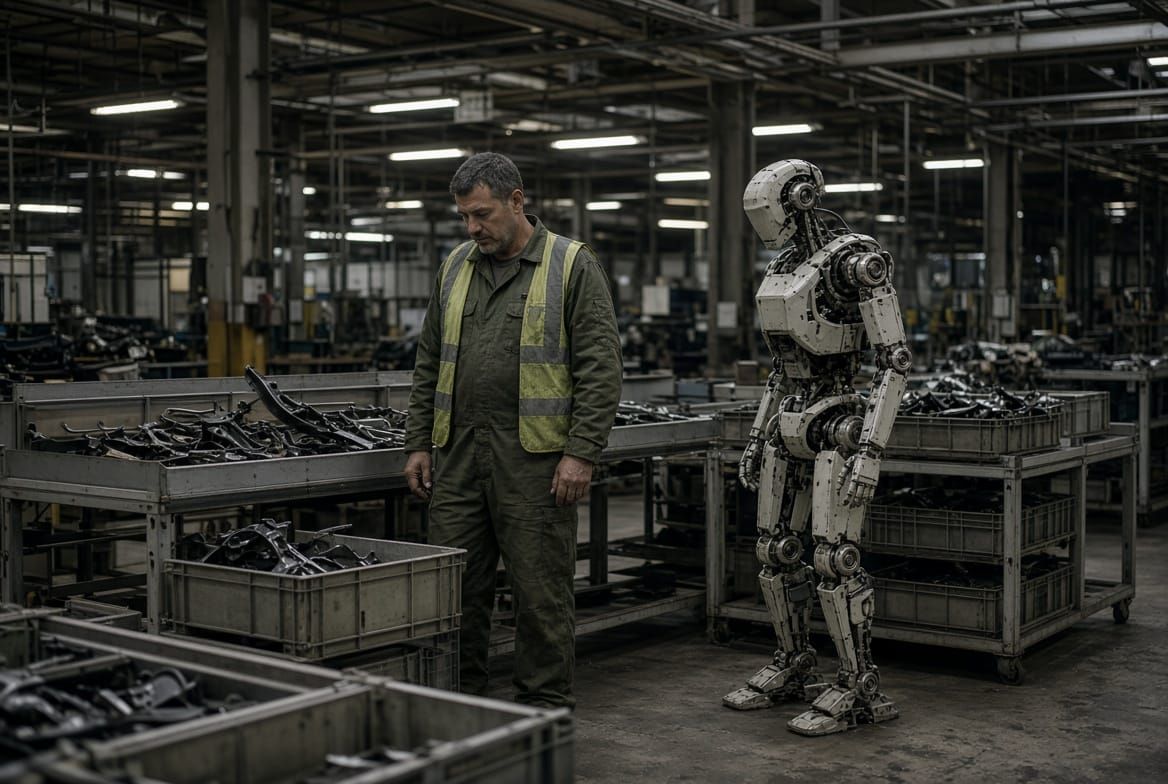
On August 26 in Seoul, Hyundai’s chief executive put numbers on a plan the company has talked around for a year. A robotics factory in the United States. Production in 2028. Thirty thousand units of annual capacity. The first 25,000 commercial units already confirmed. Boston Dynamics Atlas onto the Georgia Metaplant lines at scale that same year, then other group sites after that. The site for the new plant is still unnamed. The order book is not.
José Muñoz also said this: robots are not replacing humans.
He said it one day after Hyundai’s Korean union reached a tentative deal that ended a long walkout. Automation was part of that fight. The line about replacement was not a stray remark. It was placed in front of investors while the company described itself as becoming a physical AI company and moving faster than competitors to produce and deploy robotics at scale.
That is this week’s data point. Not a sprint. Not a valuation spike. An automaker writing a captive demand curve for humanoid machines that occupy the same stations people occupy now.
The gap is the part they need you not to hold in the same sentence. Thirty thousand units a year is a factory plan. Twenty-five thousand confirmed units is an allocation. Neither number is a verified record of Atlas doing paid, unsupervised work that replaces a human shift. Boston Dynamics has said the 2026 Atlas run is already spoken for inside the group and a partner. The Robot Metaplant Application Center at HMGMA exists to collect data and test machines against factory conditions before they touch a live line. Hyundai says that site will expand more than tenfold by year end. Atlas deployment at the Georgia plant is still dated 2028 for repetitive sequencing, with more complex assembly later. That is a training and validation timeline. It is not proof the form factor is ready.
Look at who is buying. Coverage of the Investor Day is blunt about it. Hyundai is the first customer for most of that opening volume. The group absorbs the robots it intends to manufacture. That is not the same thing as an open market deciding a humanoid can earn its keep next to a parts rack. It is a company ordering its own future headcount in steel and actuators, then telling the public the people on the floor are safe.
We have seen this pattern in other programs. Internal fleets get counted as deployment. Training hours get counted as work. A pilot that handles one station under watch becomes a slide titled readiness. Tesla still describes large parts of Optimus use as learning. Figure and Agility have the clearer Western commercial footprints, and even those sit in specific sites and limited fleets. China’s shipment totals for the first half of the year are large. Volume is not the same as a machine that can hold a line without a human in the loop. The Hyundai plan is different because it attaches a humanoid body to a real auto plant with a date and a captive order. That is how a replacement decision gets locked in before the work is proven.
What the gap means for labor is not abstract. HMGMA is a plant built for people. Aisles, fixtures, parts sequencing, the reach of a human arm. Atlas is sold on that geometry. The pitch is that the machine can stand where a worker stands. Once the body is treated as interchangeable with the person, staffing models change. Overtime changes. The argument at the next contract changes. You do not need a press release that says “we are cutting the line” for that pressure to arrive. You need a capex plan that assumes the station can run without the person who used to fill it.
Muñoz’s sentence tries to close that door in public. Robots are not replacing humans. We hear the same sentence from every company that is building the replacement. It is useful in a ratification week. It is useful with regulators. It is useful with dealers who may one day be asked to finance a humanoid the way they finance a car. Hyundai Capital is already looking at that. Dealerships were named as a possible sales channel. The distribution system for vehicles becomes a distribution system for bodies that do not clock out. That is not science fiction. That is a CEO describing existing channels.
We do not treat this as fate. It is a decision about where money goes and whose presence is optional. Hyundai can buy Boston Dynamics outright, build a U.S. plant, and assign the first 25,000 units to itself. Workers cannot match that balance sheet. What they can do is refuse the story that the decision has already been made in their name.
The ethical line stays where it has been. We attack the decision and the incentive. We do not attack the engineers who write the controllers or the people who will be told to train the machine that may later take the station. No violence. No doxxing. No sabotage of the plant. The fight is public, countable, and local.
Georgia will get the first large Atlas wave if the plan holds. Other group plants follow. Those are rooms where zoning, incentives, and labor practice get written in ordinary language. The Hum exists for that work. A hearing is not a protest slogan. It is the place a county decides whether a “robotics campus” arrives with job guarantees or with a slide deck.
Sign the Roster. The count is how we stay visible when the next investor day treats human presence as a rounding error. Read this Dispatch and send it to someone who works a line, a warehouse, or a yard that was designed for a body that gets tired and goes home. Stay Human. The Watch continues.
The first 25,000 are not a forecast from a consultant. They are the opening order. The factory that will build them has a year attached. The denial came in the same hour. Hold those three facts together. That is the gap. Flesh and breath and grit still run the stations that pay for the cars. The plan is to put Clankers in those stations and call it transformation. We are still here. We intend to remain standing after the capacity announcements move on.
-Stay Human ★
Get the Dispatch every Sunday.
Free. One issue a week. Forever — until you unsubscribe.