
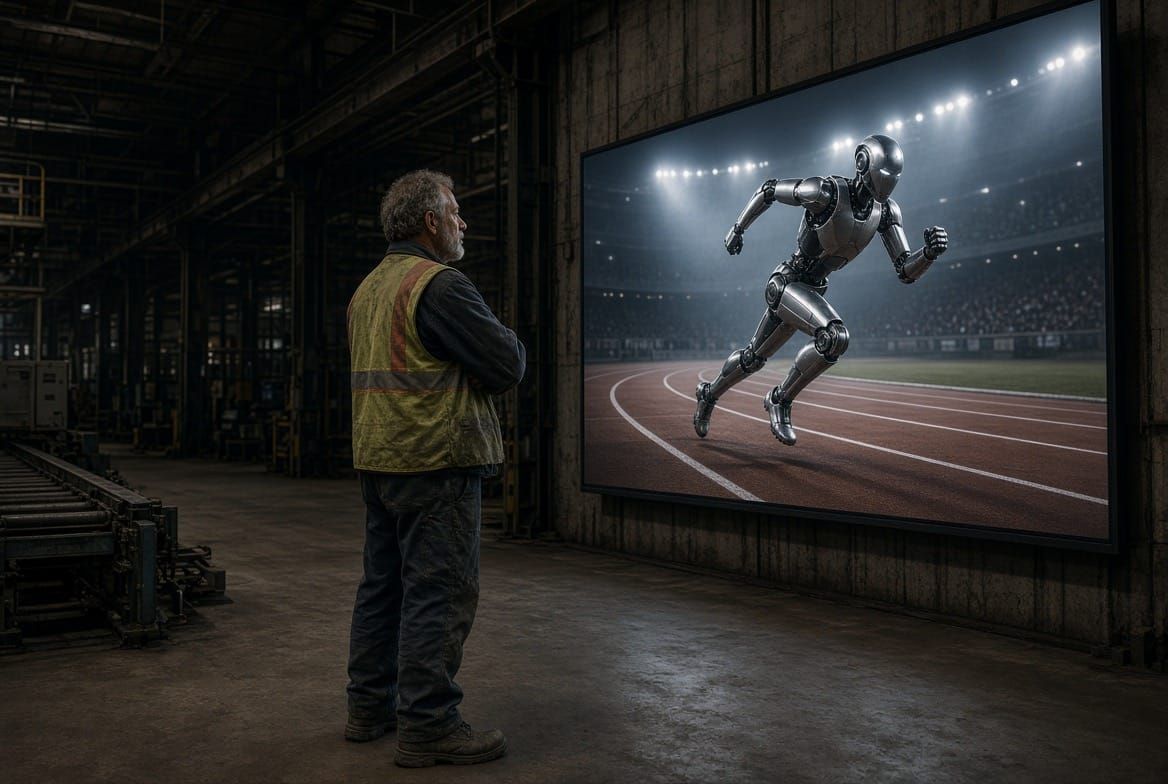
The second World Humanoid Robot Games opened in Beijing last Saturday. More than two thousand humanoid robots entered from sixteen countries. On the opening day a machine from the Beijing Humanoid Robot Innovation Center ran one hundred meters in 9.39 seconds. A trial run by Honor’s Lightning earlier the same day hit 9.32. Both times beat Usain Bolt’s human world record of 9.58 set in 2009. Another robot cleared a standing high jump of 2.88 meters, past the human mark of 2.45.
Hundreds of the machines marched onto the field in formation. The organizers call it an Olympics for robots. The events include sprints, jumps, table tennis, soccer, and staged work scenarios. Last year’s best 100-meter time was 21.50 seconds. The leap is real.
These times were set on prepared surfaces under controlled conditions with machines optimized for the task. Legs were lengthened. Cooling systems were tuned. Balance controllers were refined for straight-line speed and recovery from impact. The same engineering does not yet deliver a robot that can walk a full shift through a changing warehouse, handle novel objects without failure, recover from unexpected contact, and stay productive without constant human oversight. The paid deployments that exist still concentrate on tote movement, parts presentation, and packing on structured lines. Documented operating hours remain small next to the labor of a single large facility. Accuracy holds in the lab and drops when the environment shifts.
The Games sell the future as already arrived. Capital and policy treat the humanoid form factor as a labor substitute in the making. The public spectacle of speed and height builds acceptance. It frames the machines as impressive athletes rather than tools designed to stand where a person stands. The quieter work continues in factories and warehouses: more units shipped, more multi-year order language signed, more production capacity claimed. China accounts for the large majority of those shipments. The Games are the national stage for that industrial push.
We do not deny the engineering. The actuators and balance control that produce a sub-ten-second hundred meters are the same systems that will one day walk a floor. That is exactly why the gap matters. Capability on the track is not the same as readiness to replace a human shift. Treating the two as identical is the decision we refuse.
A robot that runs faster than Bolt will not bury its mother. It will not carry the knowledge that only comes from years of standing in the same place. It will not bleed for anything it loves. Those things are not inefficiencies to be engineered out. They are the measure of a human workplace.
The track has its records. The floors still run on flesh and breath and grit.
Sign the Roster. Watch the next Dispatch. Check the hearings in your city through The Hum.
Stay Human.
Get the Dispatch every Sunday.
Free. One issue a week. Forever — until you unsubscribe.