
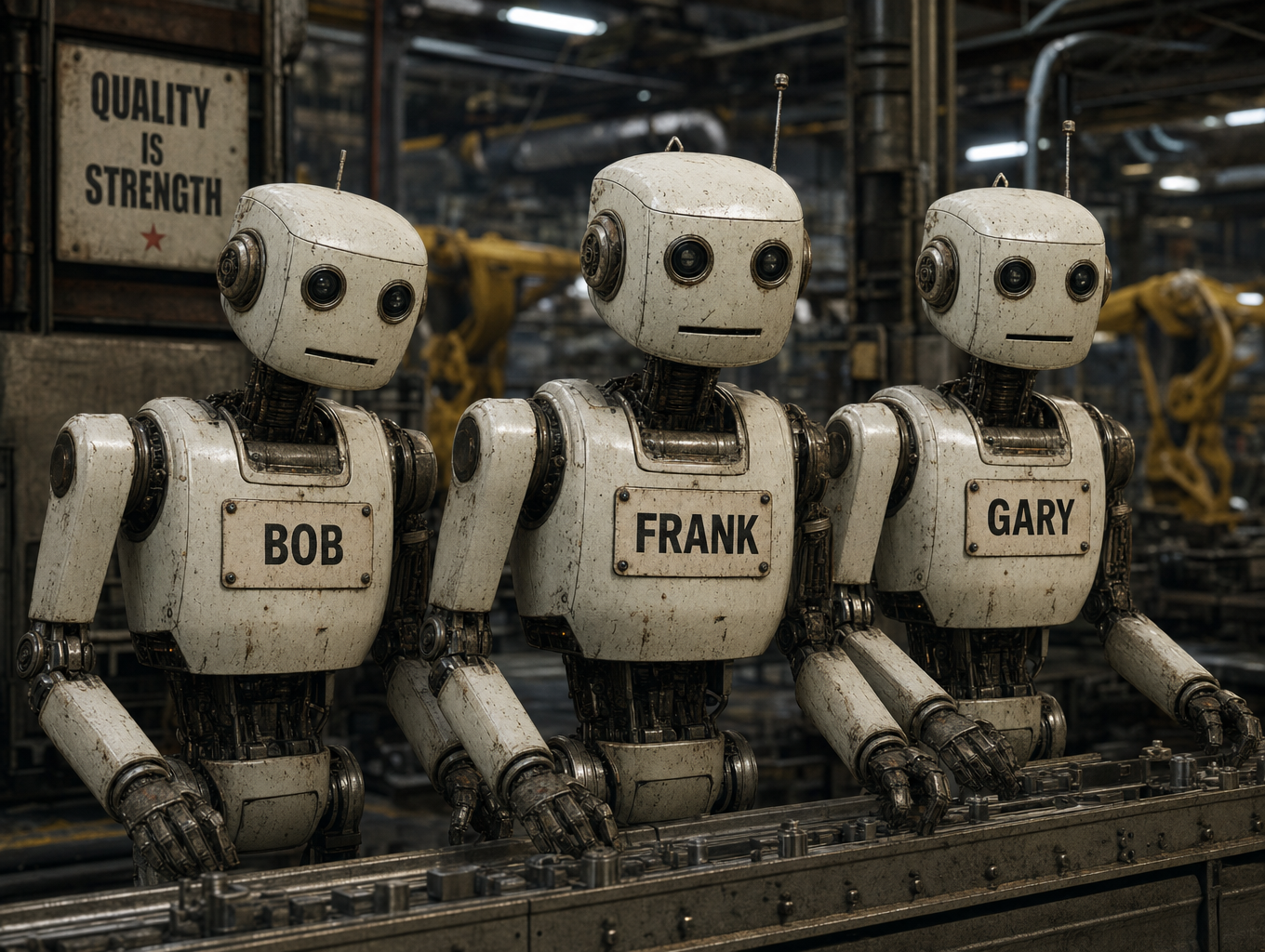
A Wall Street analyst dared a humanoid CEO to prove his robots could work a shift. By Friday they had worked three. The audience gave them names.
On Wednesday, May 13, at the start of an unedited YouTube livestream from a Figure AI test cell, three humanoid robots began sorting packages. By Friday afternoon, viewers had watched them work for over thirty hours straight, sort more than 38,000 parcels at roughly 2.6 seconds each — under human-parity speed — and acquire, from the chat, by audience acclamation, the names Bob, Frank, and Gary. Figure added the name tags. The broadcast kept rolling.
The setup ran a week. On Monday, May 11, a humanoid portfolio fund listed on NASDAQ under the ticker $BOT, the first retail-friendly single-stock basket of robotics names. The fund's diligence director, Scott Walter, used his new public seat to do something the buy side usually avoids in print: he set a bar. On Tuesday he wrote on X that humanoids would have limited utility until they could match human speed and demonstrate an 8-hour shift of autonomous labor with no human intervention. Brett Adcock, Figure's CEO, replied that the company already does this every day. Walter rebutted: words are cheap, prove it. Adcock answered with the We'll do it live meme and the line, Texting the film crew, livestream tomorrow. Five days from challenge to thirty hours of footage. By any honest reading of capital's rules, Adcock won the bet.
What the stream showed was one motion. Detect a package's barcode. Pick the package off a feed line. Reorient it barcode-down onto a conveyor. Repeat. Three Figure 03 humanoids in rotation, each carrying its own onboard compute, each running a January-2026 vision-language-action model called Helix-02. No teleoperation. No cloud. When a robot detected a fault, it walked itself off the line and called for a replacement. The original goal was eight hours. They hit eight and Adcock decided to keep going. They hit twenty-four and he called it uncharted territory. They hit thirty and over ten million people on the broadcast and on X watched it happen.
The story being sold is operating-model evolution. The capital read: the unattended shift is the central commercial question, the unattended shift was cleared on camera, and any further critique is goalpost-moving. The footage is real. The neural network is real. The autonomous failover is real. The throughput is real. We do not say it isn't. Our quarrel is with the equation. Thirty hours of one motion under controlled lighting is uptime. A shift is not uptime.
A warehouse shift at a UPS Worldport sort line, at an Amazon fulfillment center, at a FedEx Indianapolis hub, is the sort and everything around it. It is the damaged parcel pulled before it jams the feed. It is the partner whose break needs to be covered. It is the manager who has to be told the scanner is reading wrong. It is the oversize box that has to be lifted safely because nobody else is close enough. It is the body knowing the room. Even Peggy Johnson, the CEO of Agility Robotics — which builds these machines for a living — has been saying for two years that the industry is full of demoware. Backflips and coffee. The question is not what a robot can do for a camera. It is whether it can deliver inside a customer's building, where the customer has other problems and the building does not stop moving. The footage from this week is a spec sheet for one motion repeated tens of thousands of times. The shift it claims to be is not.
There are CEO voices the other way, and we hold them honestly. Brad Garlinghouse of Ripple said at Consensus Miami this month that AI does roughly seventy-five percent of his company's code, and that this is exactly why Ripple is not cutting people — the gain compounds when humans stay. Sam Altman said in February that almost every company doing layoffs is blaming AI whether or not it is really about AI. Two voices we will take. Hope, not faith. Garlinghouse is one boardroom away from a different decision and so is everyone else.
What is coming next, on a clock you can read. BMW Group this month announced its first humanoid deployment in Germany at Plant Leipzig and a new Center of Competence for Physical AI in Production. Amazon is reported, per New York Times-sourced internal documents, to be planning roughly six hundred thousand worker replacements; the company already runs about a million robots inside its fulfillment network. UPS is in the middle of a nine-billion-dollar automation buildout. Twelve to eighteen months from now, the on-camera challenge demo will not be the news. The news will be the third or fourth Amazon hub that quietly converts a sort lane to humanoid rotation overnight, with nobody named in any memo. The challenge-and-meet cycle becomes routine. The trade press calls it maturation. The floor calls it Tuesday.
The chat called them Bob, Frank, and Gary. Figure added the name tags. Those are the names of people. The package sorters at Worldport, at BWI2, at Indianapolis, who do that motion eight hours a day for about seventeen dollars an hour — some of them have those names. All of them have names. The pillar this week is the one we have been building toward since spring: the future is built by hands, not specs. Specs do thirty hours of one motion under a camera. Hands do the shift, and the next shift, and the one after that, and the rest of a life around them.
What to do this week. You will cross paths with someone whose work moves goods or keeps a building running — the driver who hands you a package at the door, the person restocking the cooler at the corner store, the custodian on your floor you have walked past for two years. Ask their name. Use it the next time. And if AI comes up in your own meeting or Slack thread this week to explain a headcount decision, ask out loud whose name fits the gap the percentage left behind. The chat named the machines because the audience knows whose names those are. We name the humans back.
— Stay Human ★
If a friend forwarded this, sign the Roster at cancelclankers.com. It's free. The count is public. Every name is a vote against quiet acceptance.
Forward this to one person whose work has a name on it. That is the whole campaign in one motion.
Follow @cancelclankers on X, Facebook, Bluesky, Threads and Instagram for the field reports between Dispatches. Card-carrying humans back the work at cancelclankers.com/cell — deeper issues, early drops, a card with your name on it.
Get the Dispatch every Sunday.
Free. One issue a week. Forever — until you unsubscribe.