
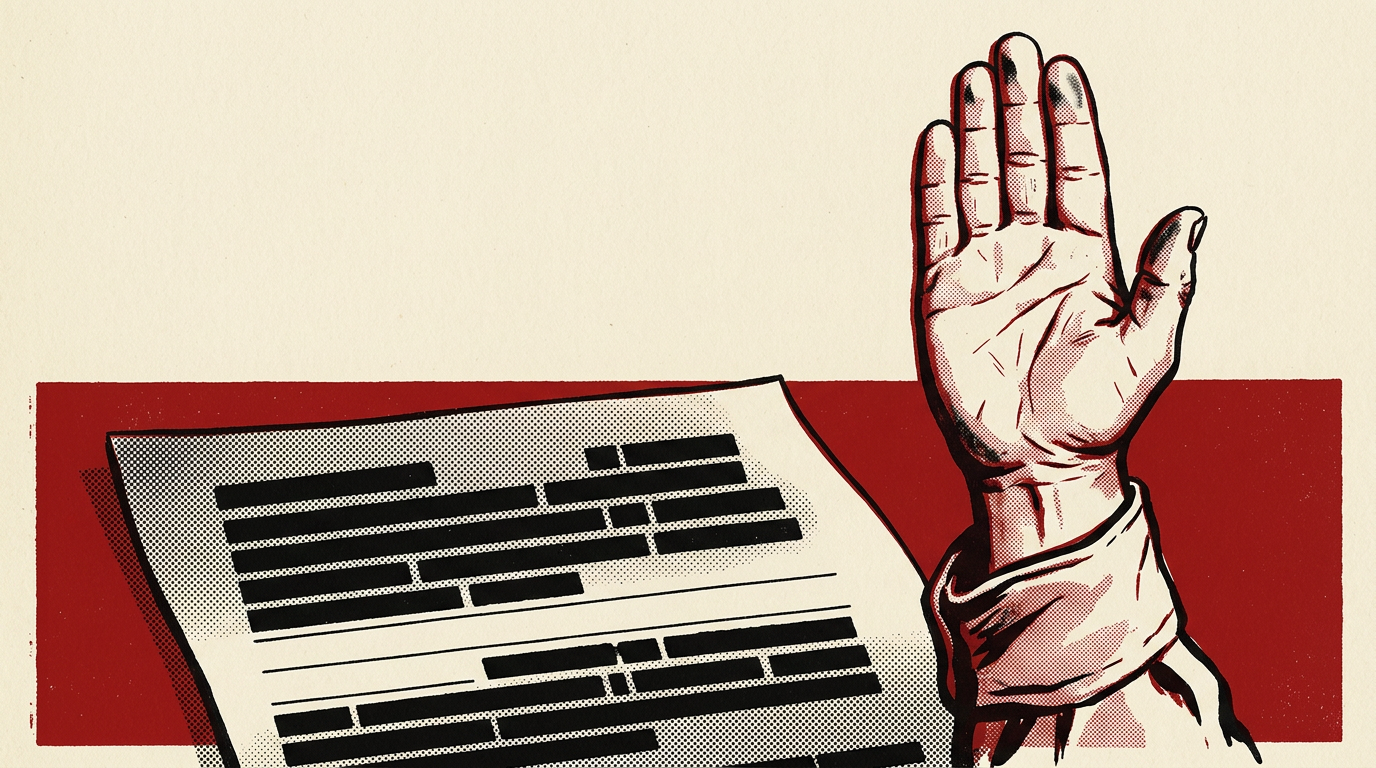
Oracle blamed AI in their SEC filing. New York State asked for the same information for a year and only got a blank page in return.
On June 22, Oracle filed its annual report with the Securities and Exchange Commission. It reads like the tax code, and almost nobody outside a trading desk ever opens it nor would they ever want to. Down in the section discussing risk sits a sentence the company has never put in a federal filing before: "The adoption and deployment of AI technologies across our operations have resulted, and may continue to result, in reductions to our workforce." They didn't put that out for the whole world to see, they buried it in corporate filings. It is a 10-K and Oracle said plainly that AI cut jobs, so there is no denying it now. During the same fiscal year the headcount at its offices fell by about 21,000, close to 9,000 of those employees were in the United States. The cost to cut those jobs and pay them out came to $1.84 billion, five times what it was the year before. Even at that high price point Oracle said "have a nice life."
News and social media focused on the other hand. They did not show you the cost to kick those workers out the door but rather they showed the growth story: capital spending up 162 percent to $55.7 billion, most of it data-center concrete, the stock climbing with it. On screens this month the machine is a rocket, which is all they care about (little green trend lines). The layoff is just part of a larger restructure to focus on the future of AI or whatever nonsense CEOs let slip out of their mouths to excuse the loss of jobs that real humans relied on and executed competently.
The much-preferred term over layoff on Bloomberg or CNBC this week was "AI-native." Two weeks before Oracle's filing surfaced, the hotel-software firm Mews cut about 170 people, 15 percent of its staff, most of them in support and onboarding roles, the ones who answered a hotelier's questions and walked a new property through its first week. Founder Richard Valtr told Skift the eliminated roles were "built for an era that is ceasing to exist." Read that again with the people he is talking about in mind. An era ceasing to exist is how you say a person got a layoff notice, dressed up so it sounds like a weather event that happened to you instead of a decision that you own. On a stage, "going AI-native" raises money. In the paperwork underneath, it reads as names and severance payouts and percentages that nobody prints and the public never reads.
For more than a year the country has run a live test of what companies say about AI when candor is optional, and it came back empty. In March 2025 New York amended its layoff-notice system to ask employers one question: was this cut related to AI? In the twelve months since, not one company has answered yes, while Challenger, Gray & Christmas counted more than 48,400 job cuts nationally that employers or reporters tied to AI. Either the technology stopped touching New York payrolls the exact month the state started asking, or the question was optional and got treated that way. It certainly is at least suspicious that not one job was lost in New York to AI in one year of those 48k. A disclosure nobody is required to file is a disclosure nobody files. That blank page is why Oracle's sentence carries weight. It showed up in the one place where anything less than the truth costs money.
We will say the thing that cuts against us, because it separates us from the hype merchants selling the other direction. AI is sometimes a cover story, not a cause. Paul Osterman at MIT Sloan points out that companies have sold "smaller teams, more productive workers" for two decades: "They've been saying that for 20 years." Better than half of layoff events now name AI, and the firms cutting deepest often pour hundreds of billions into the buildout, so "efficiency" doubles as a respectable label for ordinary cost-cutting. That sharpens our point rather than dulling it. A good-faith number is the only thing that could tell a real AI cut from a marketing one. The Oracle filing beats any CEO quote because lying in it has a price attached.
Look at what comes next: the fight is already drafted. The one federal proposal that would force a real figure is the Great American AI Act, a discussion draft from Representatives Jay Obernolte and Lori Trahan. Its best worker provision would amend the layoff-notice law so that when AI is a substantial factor in a mass layoff, the notice has to say so, describe the AI system, and estimate in good faith how many jobs it took. That is the number New York asked for and never got, made mandatory nation-wide. The trouble is where it sits: inside a three-year freeze on state AI laws that the AFL-CIO, the AFT's Randi Weingarten, and the AFA-CWA's Sara Nelson have all lined up against, calling the package a giveaway to a handful of trillion-dollar companies. Labor's objection is not that worker transparency is bad. It is that a good rule should not be the bait on a hook that also cancels the state protections workers lean on right now.
What to do this week needs no one's permission. Tell your representative you want a standalone AI-layoff disclosure rule, a real notice with a real percentage and teeth behind it, and that you do not want it bundled into a preemption that trades away your state's laws to get it. A required number with no enforcement would read exactly like New York's blank page, so the ask is disclosure that bites. Read the AFL-CIO's public letter so you can argue the bill itself, not a press release about it. And if you were cut this year with AI named or hinted as the reason, write down what you were told and by whom, and keep it. That estimate would be the closest thing to a name those workers ever get on the public record. Until it exists, the record keeps itself, one dated note at a time.
Don't overthink the ask. We wrote the letter for you. Scroll to the template letter to your representative at the bottom, copy it, fill in the four blanks, and send it. Two minutes. That is the whole assignment.
A job is not a line item in a risk disclosure. It fed a family, it taught the new hire, it held up a corner of a town, and it is owed an honest accounting when it ends. Right now that accounting exists in exactly two places: where an auditor is standing over it, and where it sells the next quarter. Everywhere a worker might actually reach for it, the field is still blank.
— Stay Human ★
Copy this. Send it to your representative.
Use the letter below as a template. Find your U.S. House member at house.gov/representatives/find-your-representative, paste this into their contact form or an email, fill in the four bracketed blanks, and send it. Make it your own if you want. The point is that it lands.
Dear Representative [LAST NAME],
I am a constituent in [CITY / ZIP]. I am writing about how the federal government handles layoffs caused by artificial intelligence, and I want to be clear about what I support and what I do not.
I support a standalone AI-layoff disclosure rule. When AI is a substantial factor in a mass layoff, the employer should be required to say so in the layoff notice, describe the system involved, and estimate in good faith how many jobs it eliminated. That estimate should carry real enforcement behind it. A disclosure with no teeth is worthless. New York asked employers a version of this question for a full year and received a blank page in return, while tens of thousands of AI-related cuts were counted nationwide. A number nobody is required to file is a number nobody files.
I do not support attaching that rule to any measure that freezes or preempts state AI laws. The worker-transparency provision in the Great American AI Act sits inside a multi-year moratorium on state action. I am not willing to trade away the protections my state can enact today in exchange for one disclosure rule tomorrow. A good rule should not be bait on a hook that cancels the safeguards workers rely on right now.
Please support AI-layoff disclosure as its own standalone requirement, with enforcement, and please oppose any federal preemption of state authority over AI. I would appreciate a written response describing your position on both points.
Thank you for your time.
Sincerely, [YOUR NAME] [CITY, STATE / ZIP]
Get the Dispatch every Sunday.
Free. One issue a week. Forever — until you unsubscribe.