
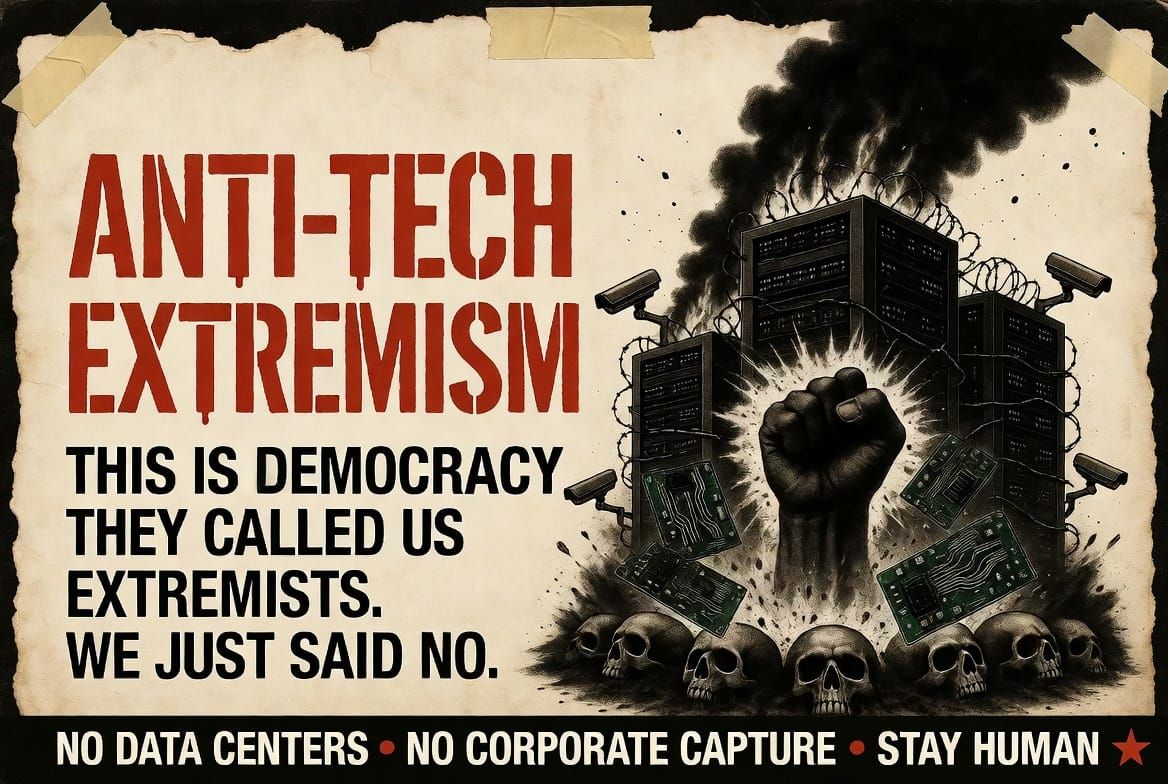
The federal government just created a new threat category for people who don't want a data center in their backyard.
WIRED dropped a piece today. Documents obtained by the magazine show that federal law enforcement is raising the alarm about a "new category of threat" — what they're calling "anti-tech extremism."
Read that again. Anti-tech extremism.
Not a fringe movement. Not a terror cell. Communities. Voters. City council members. People who showed up to a public meeting and said "we don't want this here."
That's the new threat.
The playbook
Here's what actually happened. A 20-year-old from Texas threw a Molotov cocktail at Sam Altman's house in April. Carried a manifesto and a list of AI executive addresses. The FBI called it "planned, targeted, and extremely serious." And it was. That's a crime. Nobody serious is defending it.
But watch what happens next. One act of violence — committed by one person — becomes the justification for a new federal threat category that covers everyone who pushes back against AI expansion. The kid with the Molotov and the grandmother in Wisconsin who voted to block a data center on a ballot measure are now filed under the same heading.
We've seen this before. It's the eco-terrorism playbook. In the early 2000s, a handful of arson incidents by radical environmental groups gave the federal government everything it needed to rebrand environmental activism as domestic terrorism. The ACLU documented it. Human Rights Watch documented it. States started passing laws that classified common protest tactics — blockades, trespassing, chaining yourself to equipment — as terrorism. The arrests had a chilling effect on environmental groups for years.
Same mechanics. Different industry. Bigger money.
The numbers they don't want you to see
While the feds are building a new threat category around people who oppose AI infrastructure, here's what's actually happening on the ground.
78 local and state governments have enacted moratoriums or bans on data center construction. A year ago that number was eight.
$64 billion in data center projects have been blocked or delayed by community opposition.
Denver passed a data center moratorium unanimously. Seattle's city council is considering a one-year freeze. New York lawmakers introduced a three-year moratorium. Wisconsin voters used a ballot measure to block a proposed AI facility. In Independence, Missouri, voters threw out the city council members who supported a local data center.
This isn't extremism. This is democracy working exactly the way it's supposed to work.
People are looking at what data centers do to their water supply, their electric grid, their property values, their quality of life — and they're voting no. That's not a threat. That's a town hall.
But it is a threat to the companies that need those data centers built. And that's the part that matters.
Follow the money
Here's the question nobody in the WIRED piece is going to ask.
Who benefits from classifying opposition to AI infrastructure as extremism?
Not law enforcement. They already have the tools to investigate actual violence. The kid who threw the Molotov is already facing federal charges. The system worked.
The people who benefit are the companies sitting on billions in planned data center investments that keep getting blocked by voters and local officials. Microsoft. Amazon. Google. Meta. The same companies that spent $120 million lobbying Congress last year.
When community opposition is just politics, you have to negotiate. You have to offer tax incentives, environmental impact studies, community benefit agreements. You have to convince people. And lately, people aren't being convinced.
But when community opposition is "extremism," the conversation changes. Now it's a security matter. Now the FBI is involved. Now the city council member who voted for a moratorium is operating in the proximity of a federal threat category.
That's not a bug. That's the feature.
The counterterrorism strategy tells you everything
Three weeks ago, the White House released its 2026 Counterterrorism Strategy. It identifies three major threat categories: narcoterrorists, Islamist extremists, and "violent left-wing extremists, including anarchists and anti-fascists."
You know what it doesn't mention? Right-wing extremism. Despite the FBI's own data showing that right-wing extremists carried out 152 attacks and killed 112 people in the US over the past decade, compared to 35 attacks and 13 deaths from left-wing extremists. The strategy doesn't mention them at all.
So when the same federal apparatus now creates a category called "anti-tech extremism," ask yourself who that label is going to land on. The guy in a MAGA hat complaining about his electric bill? Or the community organizer running a petition drive against an Amazon data center?
The answer is obvious. And it's supposed to be.
What this actually is
Let me be clear about what's happening.
There are real security concerns when someone throws a firebomb at a CEO's house or fires shots through a city councilor's window. Those are crimes. Investigate them. Prosecute them. Nobody is arguing otherwise.
But creating a federal threat category called "anti-tech extremism" does something different. It draws a circle around all opposition — violent and nonviolent — and files it under the same label. It makes the grandmother with the petition and the kid with the Molotov neighbors in a database.
The chilling effect is the point. You don't have to arrest anyone. You just have to make people wonder whether showing up to the next town hall meeting puts them on a list.
72 years of First Amendment law says you can stand in front of a microphone at a public meeting and say "I don't want this built here." You can organize your neighbors. You can vote. You can run for city council on a platform of "no data centers." All of that is protected speech and democratic participation.
But when the federal government puts that activity adjacent to a term that ends in "-ism," the protection starts to feel theoretical.
The receipts
The tech industry spent decades telling us they were building the future for everyone. Now that communities are looking at that future and saying "not here, not like this," the response isn't better engagement or community benefit. The response is to have the federal government classify the opposition as a security threat.
They couldn't convince the voters. So they're trying to reclassify the voting.
That's not security. That's corporate capture of the counterterrorism apparatus.
And if you're not paying attention to it, that's exactly what they're counting on.
Stay human. ★
Get the Dispatch every Sunday.
Free. One issue a week. Forever — until you unsubscribe.