
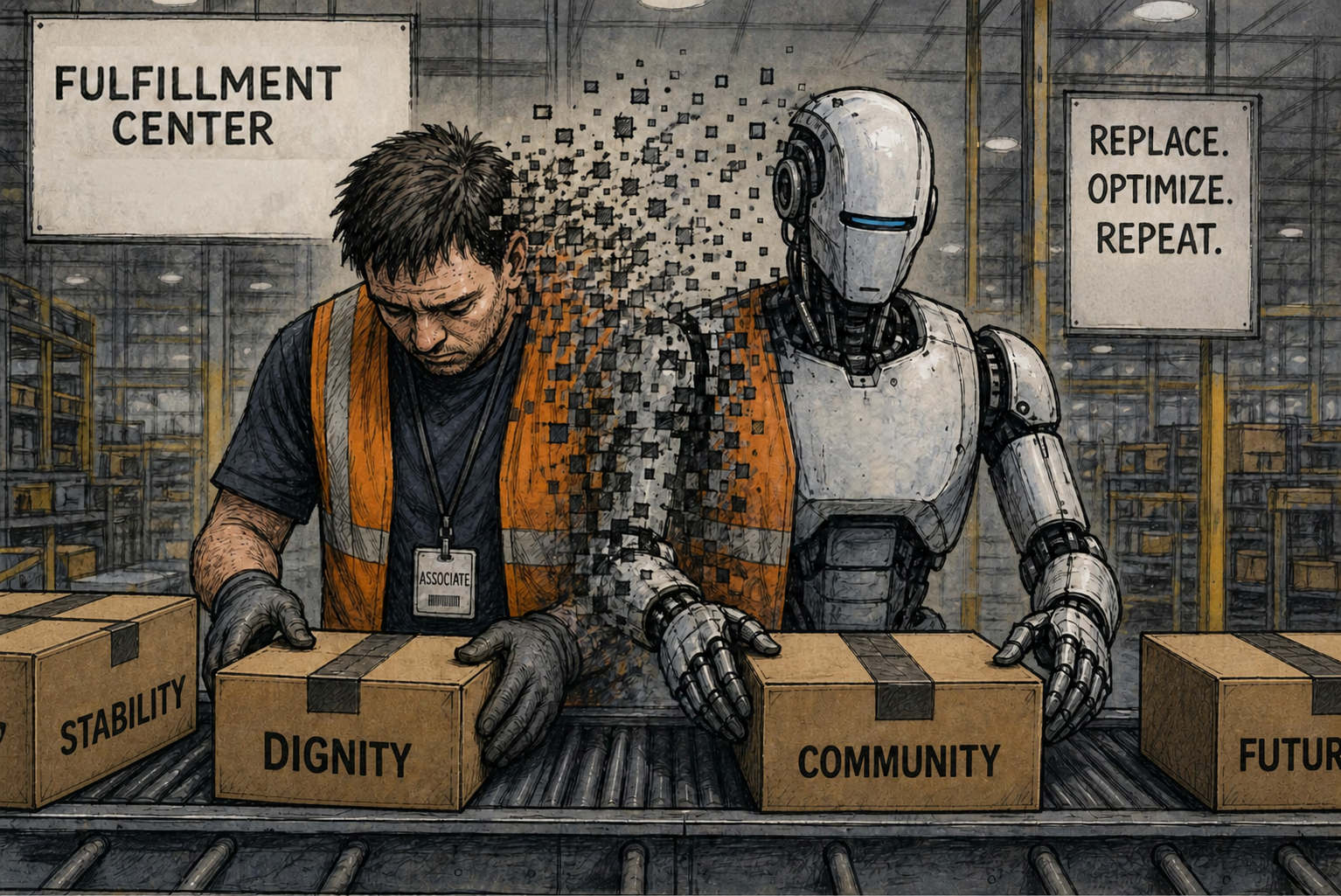
A Wall Street diligence director dared a humanoid CEO to prove the central commercial claim of the sector on camera. He pulled it off, and the deployment clock just started running.
Yesterday the bar fell. The single commercial claim the humanoid robotics industry has been making for three years — that a machine can work an eight-hour shift of physical labor with no one steering it — was demonstrated on a livestream that Brett Adcock only agreed to run after a stranger on the internet dared him to. That is the inflection. Not the next round of funding, not the next pilot, not the next edited reel. This one. The clock that runs most working Americans changed yesterday, and we don’t have a year to figure it out.
On Tuesday, on X, Dr. Scott Walter — Diligence Director at RoboStrategy, the humanoid and physical-AI fund that listed on NASDAQ under ticker $BOT a day earlier — posted that humanoids would have “limited utility” until they could demonstrate “an 8-hour shift of autonomous labor with no human intervention.” Adcock answered that Figure AI “already do this every day.” Walter replied: “Words are cheap. Prove it.” Adcock quote-tweeted the we’ll do it live meme and put a film crew on a plane. The livestream aired yesterday, the 13th of May, 2026. On camera, Figure 03 units cleared more than ten thousand packages across the shift. There was one visible miss and one unit-replacement event. No human stepped onto the floor. The bar is now part of the public record. The next demo will be cleaner. The one after that will be invisible.
Here is how the curve bends. A humanoid robot has roughly ten thousand unique parts; the CEO of the most-watched company in the sector said so on his own earnings call. Until yesterday, every buyer-side procurement team — every fulfillment chain, every automaker, every distribution giant — could refuse to sign a fleet contract because the spec sheet was a sales document and the demo reels were edited. After yesterday, the spec sheet is the demo. Contract risk drops. The pilot scales. The pilot becomes a fleet. The fleet becomes the floor.
History tells us roughly how that curve has run before. The ATM replaced the bank teller over the seven years after the first one rolled out, once the demos held and the contracts stopped requiring a human standby. The bar-code scanner replaced the warehouse picker over eight years, after integrators sorted the racking. The autoloader replaced the press operator plant by plant, after the first plant ran a full shift without a hand on the line. Those clocks ran in years.
The Figure clock will not run in years. It will run in quarters, and the reasons are already on the record. The pilots are running — BMW Spartanburg for Figure, GXO and Apptronik for Apollo, Toyota Canada Woodstock for Agility Robotics’ Digit, 1X in Hayward for NEO. The contracts have moved past pilots: UK maker Humanoid signed yesterday to deploy up to two thousand units at Schaeffler plants worldwide, first live by year’s end. Capital is fluid in a way it was not in the ATM era: Figure is valued at $39 billion, Apptronik raised $935 million, and $BOT lets retail investors buy the whole sector with one ticker. The AI software layer that runs the robot is already deployed — six American CEOs cut more than fourteen thousand jobs in sixteen days this spring and named AI as the driver. And competitive pressure from China — Unitree, RobotEra, Vbot — is collapsing every U.S. release cycle. The ATM had to overcome bank lobbies, regulators, and customer reluctance. The humanoid has pilots running, capital flooding in, software deployed, and a competitive shove from China pushing it forward. The wind is blowing the opposite way.
The room that bought yesterday’s footage was not a labor room and not a regulator room. It was RoboStrategy itself, the buyer-side procurement teams at GXO and Mercedes and Jabil and BMW Spartanburg, the boards at Apptronik and Agility Robotics and 1X who can now point at the Figure footage and tell their own investors we are next, and every diligence shop holding a position in $BOT — the public-markets ticker that turned humanoid-as-asset-class into a buyable basket in the same week the bar fell. None of those rooms know your name.
The cuts are already on the public record, and they are already named. Earlier this week, Nike eliminated 775 jobs across distribution centers in Tennessee and Mississippi, citing increased use of automation. Nissan cut 900 in Sunderland — white-collar and warehouse. Dow cut 4,500 — thirteen percent of its workforce — and named AI and automation directly. Kroger closed its Nashville automated-fulfillment facility and laid off 132. None of those workers will see a humanoid hit their floor next month. Next year is the question. The Memphis distribution-center picker, the Sunderland line worker, the Nashville fulfillment hand — they are the workers who will pay first, because they are already standing where the deployment curve is bending.
The honest case against this urgency goes like this. Humanoids right now are expensive — a hundred to two hundred thousand dollars apiece by public estimates. They are narrow. They handle a small set of tasks slowly compared to a trained human. The cost per useful hour is still higher than a warehouse worker’s, and on this view the real takeover is years off. Walter is making a version of that case when he asks for proof. The case has weight, and we respect it. Here is our answer. Every replacement technology of the last eighty years was expensive, narrow, and slow on the demo day — the ATM, the bar-code scanner, the call-center voice menu, all of them. In each case the gap closed, and closed faster than the time before. Humanoids will not be the exception, and the reasons, laid out above, point to the fastest curve yet.
Before Monday, do three things. First, write down what you actually do at work — the specific skill or motion that pays you. Not the job title; the work. That piece of paper describes what the spec sheet on the livestream is now trying to describe. Second, write to your county commissioner and your state representative and ask for a humanoid-deployment disclosure ordinance: any facility in your county that adds a humanoid to a labor line files a public notice before the unit is on the floor. Use the exact phrase “humanoid-deployment disclosure ordinance” — it gives the staffer who reads your email something concrete to search for. Third, open your 401(k) or your brokerage statement and check whether you hold any of the robotics index funds — $BOT, $ROBO, $BOTZ, $IRBO, $ARKQ. Most working Americans are now passively funding the technology being built to replace them. Naming that, even just on paper, is the first piece of clarity in a story most of us are still hearing only in headlines.
The bar fell yesterday. The deployment starts now. We have ninety days before the rest of this gets written without us.
— Stay Human ★
Get the Dispatch every Sunday.
Free. One issue a week. Forever — until you unsubscribe.