
The UAW says GM's new robots are doing union work. The grievances are filed.
James Cotton is the president of UAW Local 22, and he represents the people who build cars at General Motors' Factory Zero in Detroit. He isn't guessing about what the company's new robots are for. He's saying it on the record: the roughly fifty Fanuc-made cobots GM has bolted to the assembly line are taking jobs from the members he represents. "It's always a concern when you see a robot coming to a plant, especially after they have laid off over a thousand people," he told Crain's Detroit on June 16. "They say it's the wave of the future, and if that's so, they're taking away jobs from people." His members, he said, are disgusted from top to bottom. The local has filed formal grievances over the displacement and over the safety of machines working that close to human bodies on a moving line.
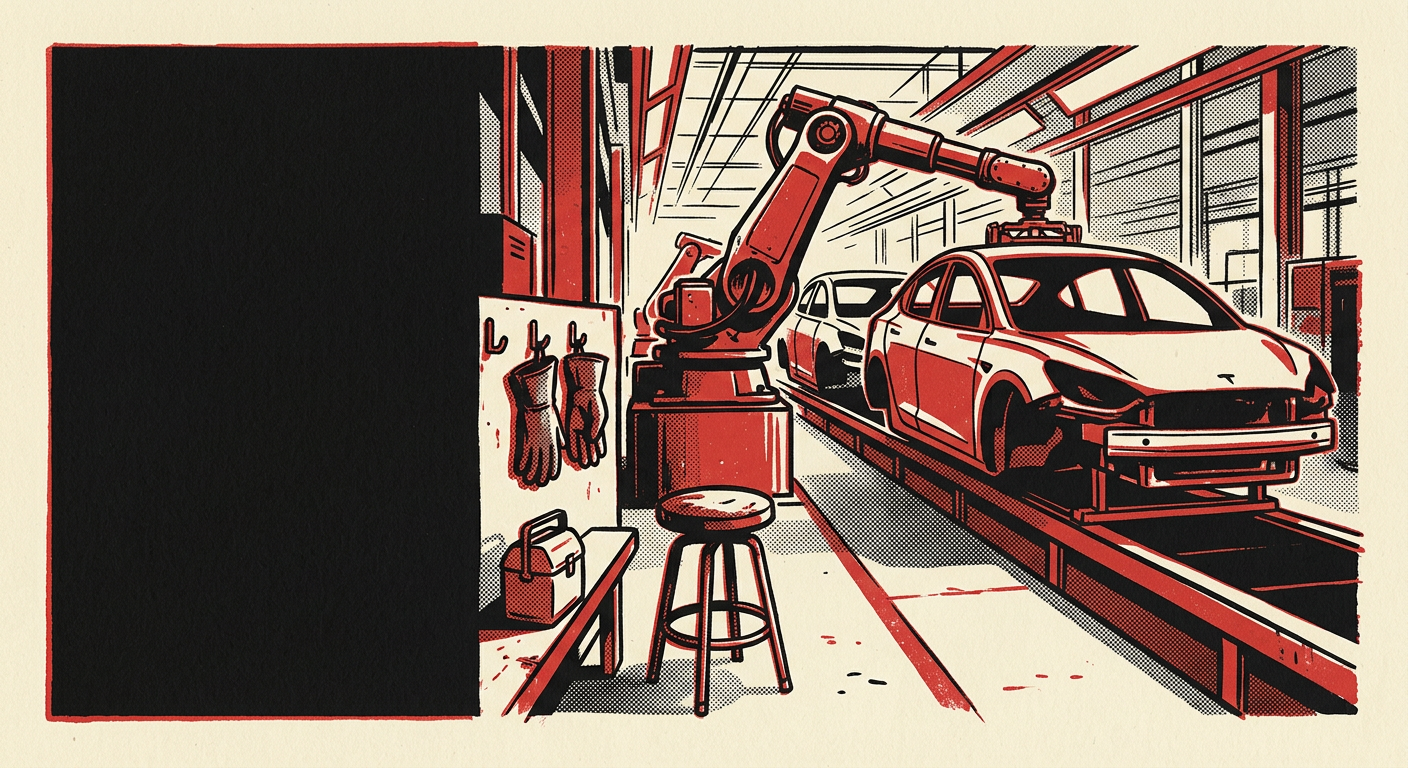
Sit with what makes this one different. Most of the replacement story runs on our reading between the lines of earnings calls. Here a union president is stating it flatly about a specific plant, and the facts around him back it up. The cobots work directly beside the remaining crew, attaching body panels to vehicles in production. This is assembly work at an auto plant, the job classification the UAW was built on. And they were installed at a plant that has been shedding people since last fall: more than a thousand members on indefinite layoff, repeated production pauses, 1,300 sent home in one stretch as EV demand came in under GM's forecast. Robots don't get hired into a plant like that to cover a labor shortage. The The Layoff Index tracks how often the machines and the pink slips share an address, and Factory Zero now sits on that list with names attached.
GM's answer came through spokesman Kevin Kelly: the cobots are part of a broader push to bring advanced technology into operations, they improve safety and ergonomics, and they keep the plant "flexible and competitive." The layoffs, the company says, are temporary and unrelated to the robots. Weigh that honestly. Fifty machines don't equal a thousand jobs, the layoffs do track soft EV sales, and a panel-mounting arm bolted to a track is nowhere near a humanoid. What GM's statement never does is contradict Cotton's actual charge. Production work that belonged to union members is now machine work, at a plant where a thousand of those members are waiting by the phone for a recall notice. "Flexible and competitive" is how that fact sounds after it clears corporate communications. We keep The Receipt Tracker for exactly this kind of translation.
The money explains the rest. The 2023 contract the UAW won raised GM's labor cost by roughly $500 a vehicle, which sharpened the accounting case for every machine that doesn't take a wage. The protection standing between members and that math is a single contract letter on the "Implementation of Advanced Technologies." Marick Masters, the Wayne State professor who studies the industry, told Crain's the union will have to come to grips with that language far more forcefully than it has, and he put the long arc behind it: building a vehicle takes 50 to 70 percent fewer labor hours than it did in the 1980s. That letter gets its real test in the 2028 negotiations, and Factory Zero is now exhibit A for the union side of the table.
Shawn Fain made the stakes explicit at the UAW's Constitutional Convention this June. "Right now, we're going through one of the most profound technological revolutions of our lifetimes with artificial intelligence, the threat of humanoid robotics and mass automation," he told the delegates. "It's a profound threat and a challenge to our way of life, to our economy and our political system." His summary ran one sentence: "We need to be clear about this. We are in a fight for humanity."
If a pilot program shows up on your floor while layoffs are still fresh, document it from day one: the date the machines arrived, the headcount before and after, what the vendor promised in the town hall. Cotton's grievances are why this story has names and numbers in it instead of a shrug, and dated records are what a grievance stands on. Search your own company in The Employer Database to see what its executives have already said out loud, add what you witnessed to The Testimony Wall, and if you build cars for a living, know that your local's paper trail this year is ammunition for 2028.
Factory Zero got its name from a promise: zero crashes, zero emissions, zero congestion. Nobody in that naming meeting said anything about zero people.
— Stay Human ★
Get the Dispatch every Sunday.
Free. One issue a week. Forever — until you unsubscribe.