
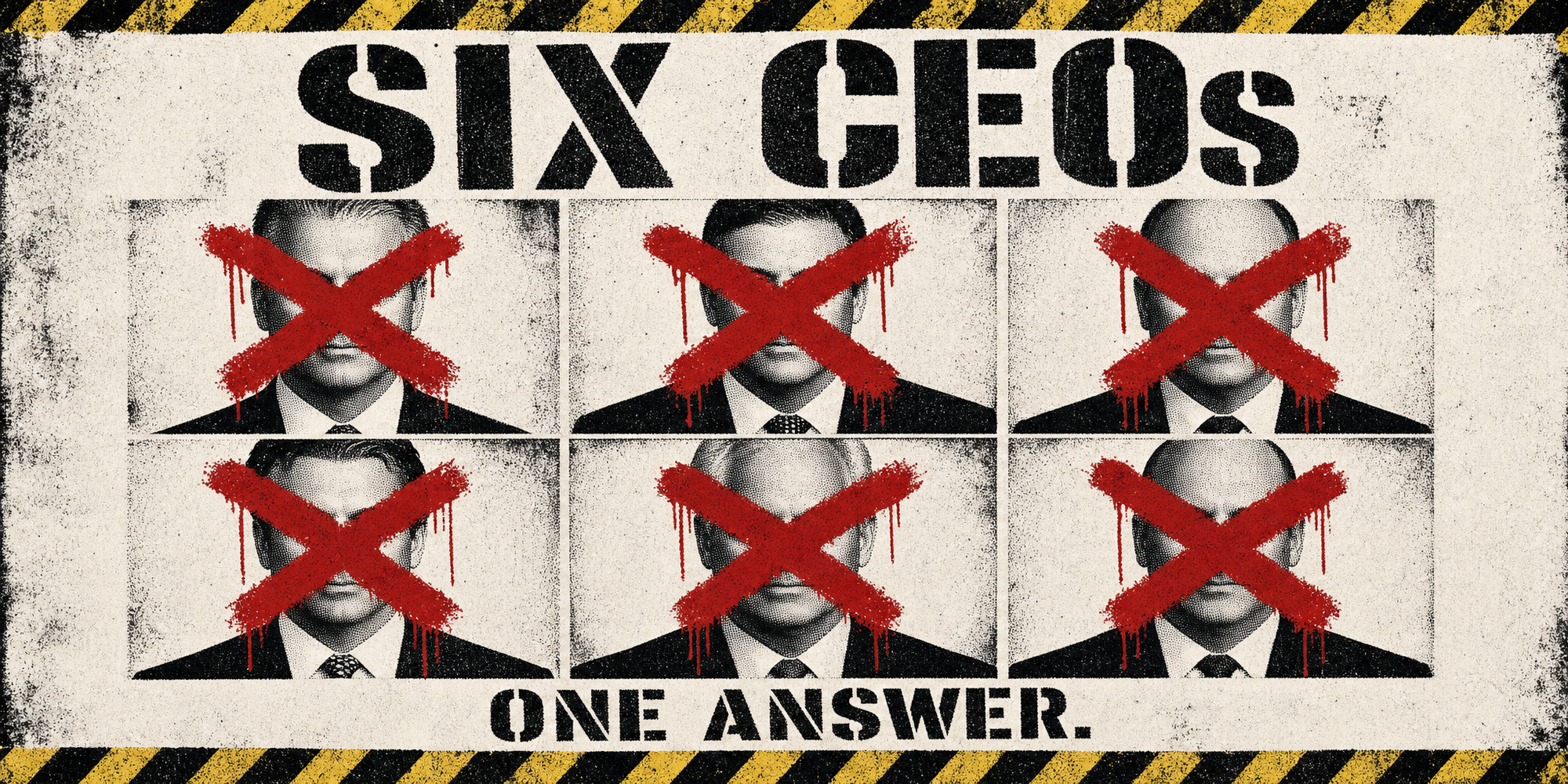
In sixteen days, six American CEOs decided the same thing. One didn't. The math was the same in every boardroom.
On Thursday, May 7, two CEOs of two unrelated public companies in two unrelated industries answered the same question on the same day with the same answer. Matthew Prince at Cloudflare cut 1,100 people — one in five workers — in a memo titled “Building for the future.” Dennis Woodside at Freshworks cut 500, one in nine, the same day, in a different city, with a different earnings call ringing in the background. Both companies had just beat or matched Q1 estimates. Cloudflare’s stock dropped roughly twenty percent after-hours anyway. By the end of the week, the count was six in sixteen days.
Write the names down. Brian Armstrong at Coinbase. Enrique Lores at PayPal. The Arctic Wolf executive team. Matthew Prince at Cloudflare. Dennis Woodside at Freshworks. Mark Zuckerberg at Meta, queued for the May 20 notification window. Six men. Six boardrooms. Six industries — crypto, payments, cybersecurity, cloud, SaaS, social media — and somewhere north of fourteen thousand five hundred American jobs put on the public record as AI-driven inside half a month. The memos run on the same script. “Lean, fast, AI-native.” “The agentic AI era.” “More than half of our code is now generated through AI tools.” “AI-focused pods.” “Becoming a technology company again.” Different writers. One document.
The story they are selling is operating-model evolution. That is the dialect. The memos open with the affective grammar of corporate honesty — “today is a hard day,” “this wasn’t an easy decision” — and pivot, inside the same sentence, into the future tense. They describe a company being rebuilt. They name what AI now does: thousands of agent sessions a day, six hundred percent growth in internal usage, more than half the codebase. They do not name a single person whose work was absorbed. The percentage is the subject of the sentence. The worker is the object. Every memo, the same grammar.
The story actually happening underneath is colder than the memos and older than the buzzwords. Six CEOs were asked the same question — what do you do with your workforce when AI hits the productivity curve — and six CEOs reached for the same lever. They did not copy each other’s prose. They are not part of a cabal. They are something more troubling than that: six executives in six boardrooms looking at the same spreadsheet and reaching the same conclusion independently. Cut the humans, keep the percentage. The decision was the contagion, not the writing. One memo is a story. Six is a pattern. The pillar — the ones replacing you don’t know your name — is not a metaphor this week. It is a literal description of every one of these documents.
There is a counter-answer in the same week. Brad Garlinghouse, the CEO of Ripple, told CoinDesk at Consensus Miami that AI does roughly seventy-five percent of his company’s code and that this is exactly why Ripple is not cutting people. The gain compounds, he said, when humans stay. He called the pattern a travesty by name. We will take the answer. We will not mistake it for faith. Garlinghouse is the public face of Ripple this quarter; his board is the math next quarter. Hope is not the same thing as faith. One CEO is one boardroom away from a different decision.
What is coming next, on a clock you can read. Challenger, Gray & Christmas put AI at twenty-six percent of all April US job cuts — already the single largest stated reason for layoffs across sectors. Twelve to eighteen months from now, the named-CEO memo will not be a story; it will be a quarterly form, the way “post-pandemic over-hiring correction” was in 2023. Expect the next wave to land in the white-collar functions these memos are already pointing at — finance ops, marketing coordinators, customer success, junior engineering — paired with the same severance theater. And expect the boomerang. Harvard Business Review surveyed a thousand executives and found more than six hundred admitted they cut staff for what AI might be able to do someday, not what it can do now. Orgvue’s research finds thirty-two percent of companies that did AI-driven layoffs have already rehired between a quarter and half of the cut roles. Gartner projects half of all 2026 AI-cited cuts will be quietly rehired by 2027, often under different titles and lower pay. The CEOs who wrote these memos this week will be the ones writing the rehiring memos in 2027. They will not call those memos “Building for the future.” They will not call them anything. They will just hire.
The brand’s quarrel is not with whether AI exists. It is doing real work. Our quarrel is with the operating model that turns the productivity gain into a layoff number instead of a human gain. The tools are not the enemy. The lever is. The hand on the lever is.
What to do this week. Print one of the six memos. Any of them. Read it out loud, all the way through, in a room by yourself or to someone you love. Notice every place a percentage appears. Notice every place a name does not. That gap — that silence where the worker’s name should be — is the thing this brand is built to fill in. Then, the next time one of those memos gets quoted on your feed, the percentage in the headline and the CEO in the byline, repost it with a name underneath. Any name. A friend’s. A neighbor’s. A stranger’s from the comments. It will be more accurate than the memo.
— Stay Human ★
Get the Dispatch every Sunday.
Free. One issue a week. Forever — until you unsubscribe.