
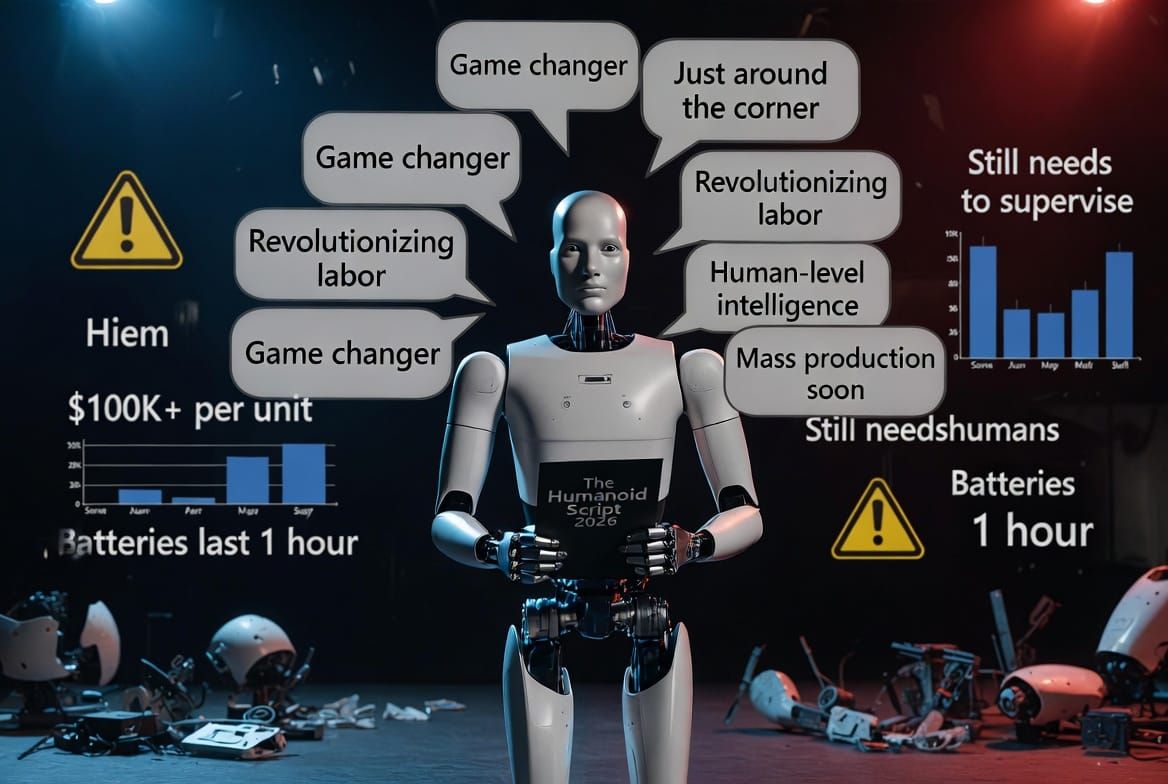
The humanoid-robot industry has a script. These are the ten lines you'll hear most this year — and what they leave out.
The lines come back word for word because the lines are working. They are on the earnings calls. They are in the op-eds. They are what your uncle types under the local news Facebook post about the new fulfillment center. Below are the ten you should know by name. None of these are made up. All of them are being said this year, on the record, by the people selling the machines to the people whose work the machines are being sold to do.
1. "They'll only do the dull, dirty, and dangerous work."
The DDD line. It sounds humane. It is also the line every general-purpose humanoid company has quietly retired from the actual sales deck. The pilots running right now are in warehouses, big-box retail aisles, hotel housekeeping, drive-through windows, and assisted-living facilities. None of those are dangerous. All of them are jobs Americans currently do for a paycheck. DDD is what the marketing team says. The contracts are about cost per hour.
2. "Robots create more jobs than they replace."
The lump-of-labor rebuttal, dressed up. It is also speculative. The job destruction is concrete — a specific worker, on a specific shift, on a specific date. The job creation is a forecast in a McKinsey deck. Forecasts are not paychecks. The 1993 forecast for NAFTA said the same thing. The Economic Policy Institute counted afterward: 766,000 American job opportunities gone by 2000, seventy-two percent of them in manufacturing. The forecast lost. The receipt was the receipt.
3. "Humans will always be in the loop."
The entire ROI model for a $30,000 humanoid requires removing humans from the loop. If a worker is still standing there, the math doesn't pencil. "Humans in the loop" is the line for the press cycle. "Lights-out operation" is the line on the analyst call. Ask which line is in the 10-K.
4. "This is just like the ATM. We adapted."
The ATM analogy gets quoted every time, usually to point out that bank-teller jobs grew after ATMs came in. The detail the analogy skips: the ATM did one thing. The humanoid is being sold as general-purpose — every physical task a human can do, at a price point below minimum wage. There is no "next job" if every physical job is on the table at once. The ATM was a tool. The humanoid is the worker.
5. "If America doesn't build them, China will."
The China card is the override switch on every emerging-tech debate. It is also the same argument that has been used to skip democratic deliberation on surveillance, on facial recognition, on autonomous weapons, on data-center siting. A global race is an argument for building the robots. It is not an argument for deploying a million units down the street against American workers. Two different decisions. The card collapses them on purpose.
6. "It's about the labor shortage, not replacement."
A labor shortage is when employers cannot find workers at the wage they are offering. The fix has always been to offer more. The humanoid pitch flips it: pay the worker less, or pay the machine once. Six American CEOs in sixteen days this spring put AI on the record as the structural rationale for cuts — Cloudflare, Freshworks, Coinbase, PayPal, Arctic Wolf, Meta. Six boardrooms. One answer. None of them cited a labor shortage. They cited a labor surplus they were now in a position to harvest.
7. "The robots are too expensive to actually replace workers."
Today, yes. Tesla, Figure, Apptronik, Agility Robotics, and 1X have all publicly targeted unit costs in the $20,000–$30,000 range at scale. Amortized over five years that is six thousand dollars a year — below any state's minimum-wage worker for a single quarter, never mind the year. The expense argument has a shelf life, and the companies making it have already published the date it expires.
8. "Robots will free people to do more meaningful work."
The meaningful-work line assumes the meaningful work pays. Most meaningful work does not. Caregiving, art, parenting, community organizing — real, and underpaid or unpaid by design. "Freeing" someone to do them means freeing them from a paycheck. A union electrician with a kid in school does not need to be freed. She needs to keep her job.
9. "AI won't take your job. Someone using AI will take your job."
This one started as an Andrej Karpathy line, got picked up by Mustafa Suleyman, made the rounds at Davos, and is now a stock phrase in every CEO interview about layoffs. It is reassuring and it is wrong about the actor. The "someone using AI" who takes your job is the CEO holding the org chart. The line is a rhetorical trick that turns a structural decision into an individual failing. If the workforce is "AI-augmented" and headcount drops thirty percent, the augmentation was the cover, not the cause.
10. "This is inevitable. There is no point resisting."
The inevitability narrative is itself a lobbying strategy. American cities were not destined to be built around the car — Americans chose, and other countries chose otherwise. Nuclear power was not destined to expand or to stall — voters and regulators made calls. The humanoid rollout is being pre-loaded with "inevitable" the same way, because inevitability ends the conversation. Minneapolis voted Thursday for a six-month data-center moratorium. The county next door votes next month. The thing being called inevitable is being voted on, in rooms small enough to walk into, this quarter.
The ten lies are the ten lies because they are working. They are showing up on earnings calls, in op-eds, in the comments under the local news Facebook post. Knowing them by name is the first part of the answer. The second part is forwarding this to the next person who repeats one.
— Stay Human ★
Get the Dispatch every Sunday.
Free. One issue a week. Forever — until you unsubscribe.