
This week the industry said physical AI had arrived. It arrived because an iPhone was strapped to a medical student's forehead in Nigeria.
"Physical AI has arrived — every industrial company will become a robotics company." Jensen Huang, the head of NVIDIA, boasted as much, making it the industry's headline of the week. At Automate 2026 in Chicago, the largest automation show in the event's fifty-year history, an NVIDIA pavilion displayed more than twenty humanoid robots for industry leaders and consumers to drool over. ABB unveiled what it calls a Physical AI Toolchain. Kawasaki rolled out an arm it billed as the first ever built for physical AI. On June 24, Morgan Stanley doubled its forecast for China's humanoid shipments this year to 50,000 units. Everywhere you looked, the same message: AI has climbed out of the chatbot, and now it wants your job.
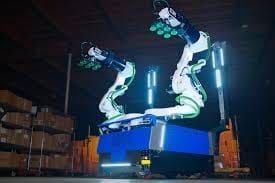
What used to be science fiction, the stuff of the silver screen, is standing on a show floor in Chicago. A humanoid folds a shirt with nobody guiding its hands, then sorts a bin of loose parts. The banner overhead promises you the rest: the machine taught itself the work, autonomy has arrived, and it was inevitable. You are the part of the process they no longer need.
Look closely at how Morgan Stanley justified that bigger number, because the honest part slipped out. The bank credited the jump to companies running "large-scale deployments to generate the data needed to improve robot performance." Read it again slowly. The robot gets better by being put on a real line, doing real work, while a camera or a sensor logs every move it copies from a person. That footage is the training data, and you are the one supplying it, motion by motion. You are the dataset.
Follow the money and you can see who comes out ahead. NVIDIA supplies the brains, ABB supplies the toolchain, and the banks talk the forecast up so investors keep pouring cash into the build-out. The companies actually buying the machines are chasing one number, the cost of human labor on the spreadsheet, and they get to cut it using footage you helped record. When it is all done, the wealth pools right back into the same handful of firms that needed your hands just long enough to build the thing that costs you the job.
Here is what they are building, and here are the hands doing the building. A medical student in central Nigeria who goes by "Zeus" comes home from a hospital shift, straps an iPhone to his forehead, raises his arms like a sleepwalker to stay in frame, and irons his clothes for the camera. He earns about $15 an hour from Micro1, a Palo Alto firm that has hired data recorders across more than fifty countries. He does not know which robot his footage trains. The company keeps its clients confidential, even from the people generating the data. In Shandong, China, a stay-at-home mom named Gao Bo films herself cooking and folding laundry six hours a day for roughly $3 an hour. "No one had paid me to cook and do laundry before," she says. In Dongguan, a data supplier pitches factory owners on strapping sensors to their workers, selling them on the day the trained robots will run the floor without those workers at all. And on a BMW line in Spartanburg, South Carolina, Figure AI humanoids already ran ten-hour shifts, trained first on hundreds of hours of people piloting them by hand through the same tasks. The welder on that line spent his shift teaching his own replacement, and got paid by the hour to do it.
We are not going to pretend the other side has no case, so here is the true part. In Japan, where the working-age population is shrinking and almost nobody is lining up for factory work, a robot in a short-staffed ward is not pushing out someone who wanted that job. Even the sellers keep their own expectations low. Elon Musk has said Tesla's Optimus is "not in usage in our factories in a material way." Ken Goldberg, a roboticist at UC Berkeley, figures the whole approach is "going to take longer than people think." The machines may not be good enough for years. What gives the industry away is where the shortage talk runs loudest: American firms posting record layoffs in 2026, AI named as the reason, swearing in the same breath that they cannot find anyone to hire.
Nobody has to smash a camera to fix the worst of this. One rule does most of the work. If your labor or your data is training your replacement, you have a right to know it, and a right to refuse. This is an already-winning principle. The SAG-AFTRA contract that takes effect July 1 puts "significant additional value" on paper, language meant to keep a performer's likeness from being harvested and reused without consent or pay. If actors can write that into a contract, so can the welder, the picker, and the woman folding laundry in front of a lens. Build the machine if you want, but stop lying to the hands building it.
They keep calling it autonomous. It runs on human labor, and it always has. The only thing the spectacle is built to hide is whose.
— Stay Human ★
Get the Dispatch every Sunday.
Free. One issue a week. Forever — until you unsubscribe.