
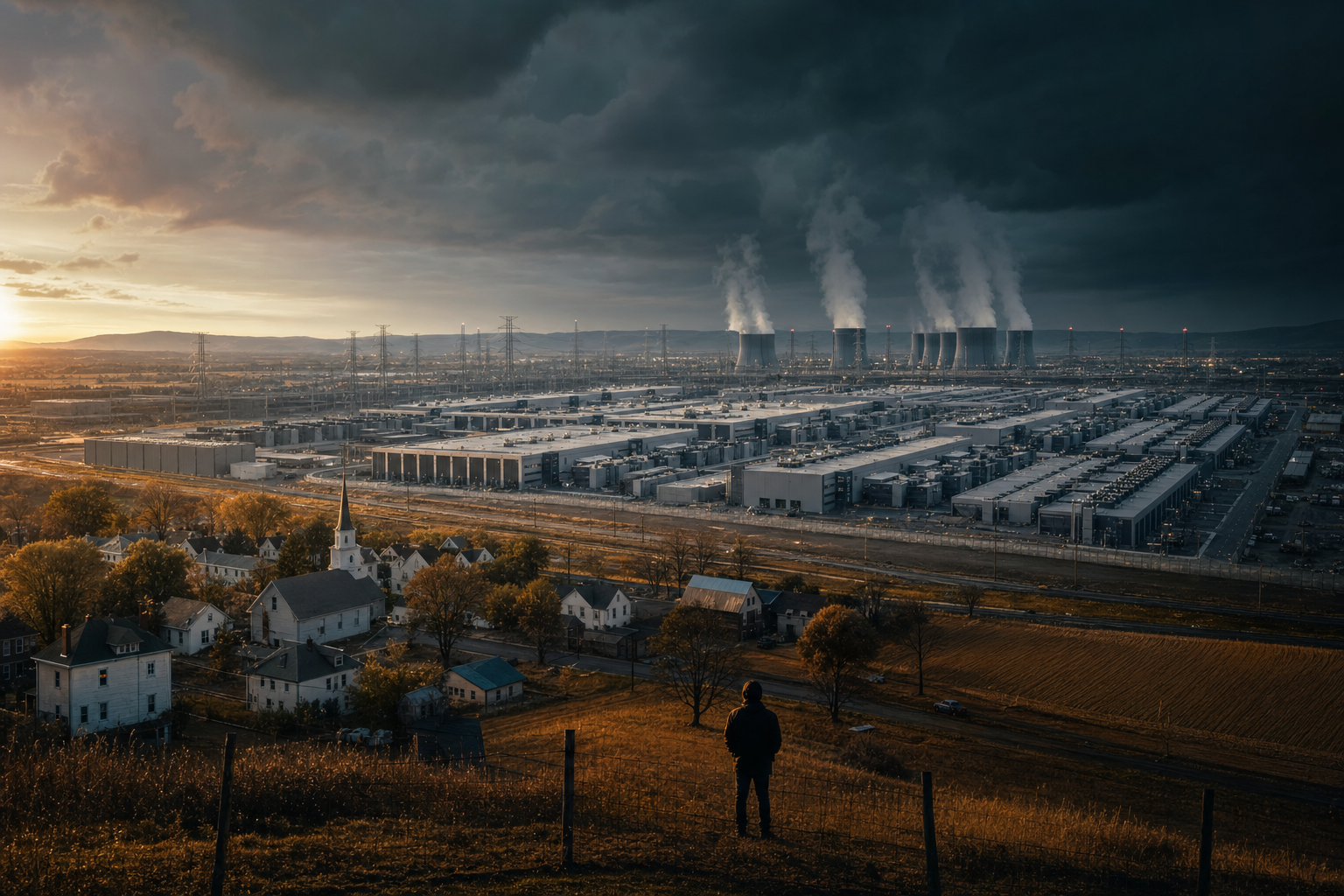
A Cancel Clankers breakdown of the strongest arguments for the AI buildout — and why they don't hold up the way you've been told.
STAY HUMAN · EST. 2026
There is a version of this conversation that never happens.
It goes like this: someone raises a concern about data centers draining local water supplies, or AI eliminating entry-level jobs, or robots hollowing out the manufacturing towns that barely survived the last round of automation. And before they finish the sentence, they get the reply.
You can't stop progress. China isn't slowing down. The data says net job creation is positive. History proves the skeptics wrong every time.
And that's it. Concern dismissed. Discussion closed.
What bothers me about that exchange is not that the counterargument is wrong. Parts of it are genuinely right. What bothers me is that it's being used to skip the harder conversation entirely — the one about who pays the cost, who captures the benefit, and whether those two groups are the same people.
They are not.
This post is an attempt to have that harder conversation. Not to argue that the technology should stop. It won't, and probably shouldn't. But to put the strongest pro-acceleration arguments next to the evidence that complicates them — so you can see both sides clearly and decide what you actually think.
Let's go through it.
"Data Centers Are Just Infrastructure. America Has Always Paid This Price."
The argument at its strongest:
Every major American infrastructure buildout displaced communities and consumed resources. The interstate highway system. The TVA. The transcontinental railroad. None of it was painless. All of it was worth it. Data centers are the utility infrastructure of the digital economy — the 21st century equivalent of power plants and rail yards. The local costs are real but they are the price of national capability, and history consistently vindicates the builders over the protesters.
This is a genuinely compelling argument. And it is the one you will hear most often from tech executives, policy advocates, and economic development offices trying to land a facility in their county.
Here's where it breaks down:
Every single historical precedent being cited came with a governance framework that is conspicuously absent from the current buildout.
The interstate was built under the Federal Aid Highway Act of 1956 — which mandated environmental reviews, community impact assessments, and required compensation for displaced residents. The TVA was a federal agency with congressional oversight and explicit social obligations to the communities it flooded. These were not unregulated private booms. They were public investments with public accountability structures baked in from day one.
The current data center boom does not have that. At the federal level, new permitting policies have actually shortened environmental review timelines and reduced opportunities for local input — moving faster, not more carefully. In Virginia, 80% of municipalities with existing or proposed data centers had non-disclosure agreements in place between developers and local officials, limiting what the public could even know about the projects being built in their backyard. World Resources InstituteWorld Resources Institute
The proponents want the historical precedent without the historical accountability. That is not how the precedent actually worked.
"The Energy Costs Will Be Offset by Efficiency Gains Across the Economy."
The argument at its strongest:
Yes, data centers consume significant energy — currently 4–5% of U.S. electricity, projected to reach 12% by 2030. But AI workloads are simultaneously making the broader economy more efficient. Optimized logistics, precision agriculture, smarter manufacturing — these reduce waste and energy consumption in ways that offset the gross consumption numbers. And the rapid buildout of renewable energy will absorb data center demand within the same decade it is created. The numbers look alarming in isolation. In context, they are manageable. Planet Detroit
Here's where it breaks down:
The efficiency gains are projected. The electricity bills are not.
Electricity costs in areas near data centers are already as much as 267% higher than they were five years ago. A Carnegie Mellon University study projects the average American electricity bill will increase by 8% by 2030 due to data centers and cryptocurrency mining alone. Those increases are landing on real households right now — not in a modeled future where AI-optimized supply chains have reduced their grocery bills. Project CensoredProject Censored
And the clean energy transition being cited as the solution? It is being outrun. Natural gas accounted for 40% of the energy used by U.S. data centers in 2024, according to the IEA, and is projected to remain the largest energy source for data centers through 2030. Project Censored
Asking the families living near these facilities to absorb real, immediate rate increases based on projected future benefits that may or may not materialize in their community is not a reasonable bargain. It is the externalization of risk onto the people with the least power to say no.
"Water Use Is a Known Engineering Problem With Known Solutions."
The argument at its strongest:
Data centers use water for cooling — a well-understood industrial process that the industry is actively working to improve. Liquid cooling, closed-loop systems, AI-optimized thermal management. The technology is moving in the right direction. The water use intensity per unit of compute is trending downward. The concern is real but it is already being addressed by the market.
Here's where it breaks down:
The solutions being cited do not yet exist at the scale the problem demands. And the infrastructure being built today will be operating for 20 to 30 years.
Since 2022, nearly two-thirds of new U.S. data centers have been built in high water-stress areas — California, Arizona, Texas. These facilities are going into the ground right now using today's predominantly evaporative cooling technology. The future solutions being offered as reassurance are future capabilities being used to justify present-tense decisions with multi-decade operational lifespans. Wiley Online Library
The scale of the ask is significant. Under even an optimistic scenario — with industry-wide water use intensity reductions of 10% annually — U.S. data centers could still require enough new water infrastructure through 2030 to supply roughly half of New York City's daily water needs, at a total cost of up to $58 billion. arxiv
In Memphis, a newly built AI data center raised alarm among residents over daily withdrawals from aging public water infrastructure. These are not abstract environmental concerns. These are communities being asked to compete with industrial-scale facilities for a resource that is already scarce — and being told to trust that the industry will solve the problem on a timeline it has not committed to. Wiley Online Library
"The Net Jobs Math Is Strongly Positive."
The argument at its strongest:
Every previous technological revolution generated identical fears, and in every case the technology created more economic value and employment than it eliminated. The World Economic Forum's own research confirms the pattern continues: 170 million new jobs will be created by 2030 while 92 million are displaced — a net gain of 78 million positions. This is not a crisis. It is the largest employment expansion in modern history. The research consensus is clear. The Interview Guys
This is the argument that gets deployed most often, and it is the hardest to push back on at the macro level because the numbers are real.
Here's where it breaks down:
Net job creation at the aggregate level does not help a displaced worker pay rent in the month they lose their job.
McKinsey projects that 12 million Americans alone will need to switch careers by the end of this decade. The 170 million new jobs being created will not be distributed across the same geographies, age groups, or skill categories as the 92 million being eliminated. A 52-year-old assembly line worker in Youngstown, Ohio, whose job is eliminated by robotics does not benefit from the net creation of 78 million positions in AI engineering and renewable energy installation in Austin and Denver. Axis Intelligence
The arithmetic is clean. The human reality is not.
And the prescription — invest in reskilling, build new educational infrastructure, create transition programs — is correct as policy direction and absent as policy commitment. The reskilling infrastructure that would actually bridge this gap does not exist at the required scale. Pointing to the GI Bill as a historical model while simultaneously opposing the level of public investment that would create a modern equivalent is an internal contradiction that the pro-acceleration camp has never resolved.
"The Jobs Being Automated Aren't Worth Saving Anyway."
The argument at its strongest:
Telemarketers. Data entry processors. Routine administrative roles. Basic content production. These are the jobs AI is displacing first. They offer low wages, limited advancement, high burnout, and minimal creative demand. Automating them is not a tragedy — it is an invitation for human potential to redirect toward work that is more meaningful, more consequential, and more resistant to automation because it requires genuine judgment and creativity.
This argument is made confidently and often. It is also the most revealing one in the entire debate.
Here's where it breaks down:
Deciding which jobs "lack human value" is a judgment that is very easy to make when your own job is not the one being automated.
Entry-level positions are not just jobs. They are the economic entry point for people without college degrees, workers returning to the workforce after caregiving gaps, people in communities that do not have access to technical reskilling programs. They are, in plain terms, the first rung on a career ladder. Anthropic's own CEO predicted in 2025 that AI could eliminate roughly 50% of white-collar entry-level positions within five years. Workers aged 22–25 in AI-exposed roles have already seen a 16% drop in employment, while experienced workers remain stable. DesignRushDesignRush
For a recent graduate entering an economy where those first rungs have been removed, the net job creation statistics are structurally irrelevant. You cannot climb a ladder that is missing the bottom half.
The argument that these roles represent low human value is easy to make from a position of economic security. It is much harder to make to the person whose economic security depended on the role you just decided was not worth saving.
"Without Robotics, American Manufacturing Isn't Competitive."
The argument at its strongest:
The U.S. lost 1.7 million manufacturing jobs between 2000 and 2020 primarily because American labor costs could not compete globally. Robotics solves this — it makes production in Ohio and Tennessee viable at a cost structure that competes with facilities in Vietnam or Bangladesh. The alternative is not preserving those jobs. It is watching them leave again.
This is the strongest practical argument for manufacturing automation, and it deserves a straight answer.
Here's where it breaks down:
Economic efficiency and community prosperity are not the same outcome. And the gap between them consistently falls on the communities that were not consulted.
Rust Belt and Sun Belt manufacturing communities — already recovering from decades of offshoring and an earlier round of automation — are now facing a second, accelerating wave of AI-driven displacement targeting the manufacturing jobs that survived the first wave. For every robot introduced per thousand workers, approximately 5.6 jobs are lost. The argument that higher-quality technical roles replace them is accurate — for engineering and maintenance positions, concentrated in metro areas with technical college pipelines. It is not accurate for the communities that do not have that infrastructure and will not for a generation. -Zoe Talent Solutions
The efficiency argument and the community stability argument are not the same argument. Winning on efficiency while losing the community is not a net American victory. It is a different kind of loss — one that shows up in mortality statistics, addiction rates, and political instability before it shows up in economic models.
"If America Slows Down, China Sets the Rules."
The argument at its strongest:
This is the most powerful card in the pro-acceleration hand, and it deserves to be stated at full strength. China is building AI infrastructure at scale without environmental review, community input, or labor protections. Every major competing economy is accelerating. American hesitation does not produce a more humane transition — it produces a world where the standards, architecture, and governance of AI are set by a country with fundamentally different values about individual rights and democratic accountability. If we slow down, we cede the future.
Here's where it breaks down:
The European Union is currently the most significant force shaping global AI governance. Not because it built the most data centers the fastest. Because it built the most consequential legal framework — the EU AI Act, the GDPR, the emerging body of AI liability law. American companies operating globally must comply with those frameworks regardless of how fast American data centers were built. Global standards are being set through legitimacy and governance architecture, not construction pace alone.
More fundamentally: the argument that America must match China's development pace implicitly accepts China's development model. China moves fast on AI infrastructure because it operates without meaningful environmental review, community input, or labor protections. If the prescription for American competitiveness is to match that pace, the prescription is actually to import the governance philosophy of an authoritarian state into American infrastructure development.
America does not win the AI race by becoming less American. It wins by building AI infrastructure that is more legitimate, more trustworthy, and more durable than the alternative. And legitimacy requires accountability — not just speed.
So What Are We Actually Arguing For?
Not stopping the build. The technology is coming and the global competition is real.
What we are arguing for is the part that keeps getting skipped in the rush to frame this as a binary choice between progress and decline.
Require water and energy disclosure from data center developers the same way we require it from every other major industrial operator in this country. That is not anti-technology. It is basic environmental governance.
Fund workforce transition infrastructure at a scale that matches the disruption — not a decade behind it. That is not Luddism. It is the lesson of every successful industrial transition in American history.
Give communities a meaningful voice in whether and how this infrastructure gets built in their backyard. That is not a barrier to progress. It is the democratic accountability that distinguishes American infrastructure from the authoritarian model being used as the justification for removing it.
The machine is powerful. That is precisely why the question of who controls it, who benefits from it, and who pays for it is not a distraction from the conversation.
It is the conversation.
Stay Human ★
Get the Dispatch every Sunday.
Free. One issue a week. Forever — until you unsubscribe.