
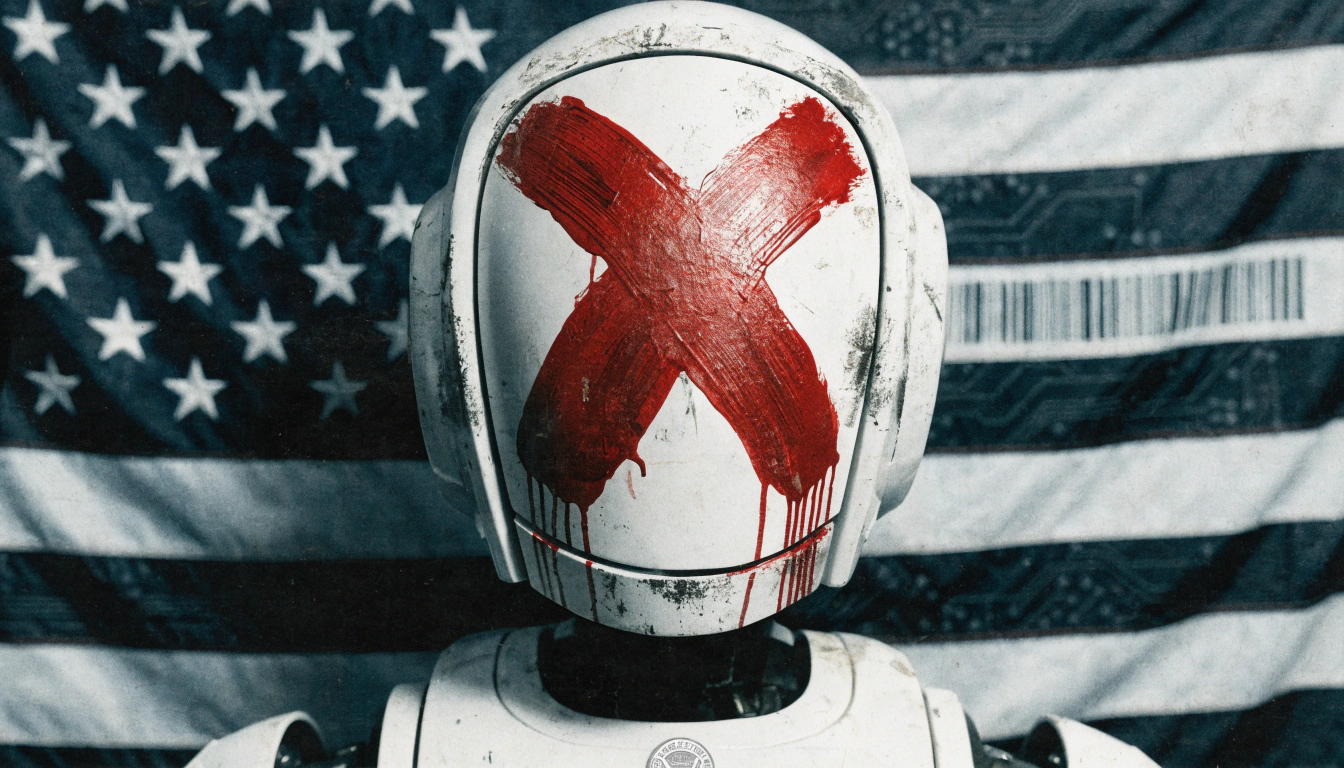
They don't need to take over. They just need to become the government.
0.
Spartanburg, South Carolina. BMW's biggest plant on Earth. Over eleven months, a humanoid robot called Figure 02 worked the welding line beside human beings — ran ten-hour shifts, took 1.2 million steps, helped build over thirty thousand X3 SUVs. It didn't get tired. It didn't file a grievance. It didn't need insurance. BMW wrapped the pilot in November 2025 and announced the European rollout the same month — at Plant Leipzig, with a different vendor and an even newer machine.
In Bavaria, in South Carolina, in a dozen places you have never heard of, the trial is over. The replacement is happening. The men and women who built cars yesterday are watching the substitute machines this morning.
And the men who own the substitute machines are on television promising you a beautiful future.
I.
In November 2025, Dario Amodei, the CEO of Anthropic, sat down with Anderson Cooper on 60 Minutes and said the following:
"I think I'm deeply uncomfortable with these decisions being made by a few companies, by a few people."
That is the CEO of one of those companies. He is right. He is also still doing it. So is every one of his peers, and they have all now told you — in their own words, on their own essays, on their own podcasts and earnings calls — how this ends.
Here is what they have collectively told you. Work is going away. They are not predicting it; they are reporting it. They will figure out how to take care of you. The mechanism is some version of universal basic income, or universal high income, or universal basic wealth, or a "capitalist economy of AI systems" rewarding humans based on what the AI thinks the humans deserve. The details vary. The promise is identical.
The promise is the cover story.
This is the actual argument: the AI abundance pitch — and the universal basic income that is supposed to come with it — is not a plan to take care of you. It is the structural shape of a merger between a handful of private companies and the state.
The companies become the government's paycheck department. The government becomes their permitting office. You get a check. They get the country.
The merger is what they are selling. UBI is what they are calling it.
That's the frame. Hold it through the rest of this.
II. The Pitch
Hold the pitch in your hand for a second before we take it apart. You should know exactly what they are saying, in their own words, before you understand why it is a story.
In 2021, Sam Altman published an essay called Moore's Law for Everything. The thesis: software will eat human labor, power will shift from labor to capital, and the only way to prevent mass immiseration is to tax companies at 2.5 percent of their market value annually — payable in shares — and distribute the proceeds to every American adult. He calculated it would be roughly $13,500 a year, per person, within a decade. He called the new arrangement "a floor for everyone in exchange for a ceiling for no one."
In November 2023, at the UK's AI safety summit, Elon Musk told the British prime minister:
"There will come a point where no job is needed."
The next May, in Paris, he refined the pitch:
"We won't have universal basic income. We'll have universal high income… It will be an age of abundance."
In October 2024, Dario Amodei published a fourteen-thousand-word essay titled Machines of Loving Grace. He argued that powerful AI could compress fifty to a hundred years of scientific progress into five to ten. He acknowledged that "our current economic setup will no longer make sense" and floated the possible solutions: a large UBI, or "a capitalist economy of AI systems, which then give out resources… to humans based on some secondary economy of what the AI systems think makes sense to reward."
Microsoft's Satya Nadella, at Davos in January 2024, told the World Economic Forum that AI could add "seven to ten trillion" dollars in new global GDP and that Microsoft's products would help people "do more with less." NVIDIA's Jensen Huang, in Dubai a month later, told a roomful of government ministers that "every country needs to own the production of their own intelligence" — and that the way to do that was to partner with him. Mark Zuckerberg, in a July 2025 letter announcing what he called "personal superintelligence," branded his version differently — an AI that handles the work, a society reorganized around the abundance it produces — but landed on the same horizon.
And in Turin, in October 2025, Jeff Bezos told a stage full of Italian executives that "we are living in a golden age." In a CNBC interview with Andrew Ross Sorkin the following May, he told workers worried about losing their jobs to AI:
"If you've been digging out a basement for your house with a shovel and somebody's about to hand you a bulldozer, you should be so happy."
Seven CEOs. One answer. Same answer, reached independently — because the structure only allows one answer if you're the one selling it. Post-work is inevitable. Abundance is coming. Someone will figure out how everyone eats. Be so happy.
Now let's go look at what the answer would have to be, structurally, for any of that to be true.
III. The Fiscal Trap
A modest US adult universal basic income — one thousand dollars a month, every adult, no means test, no work requirement — costs about $3.1 trillion a year. That is roughly 258 million American adults times twelve thousand dollars apiece.
The combined annual profit of the five most profitable American AI companies — NVIDIA, Microsoft, Alphabet, Meta, and Amazon — was about $455 billion in calendar 2025. Not their revenue. Their actual profit.
$3,100 billion divided by $455 billion equals 6.8.
To fund a basic, modest UBI for American adults from the profits of the five companies promising to fund it, the federal government would have to take roughly 680 percent — about seven times — their combined profit. Every year. Forever. OpenAI and Anthropic contribute nothing because they lose billions. Even if you confiscated 100 percent of the profits of all five profitable giants, you would cover less than fifteen percent of the cost.
This isn't tax policy. It's a fairy tale dressed up in numbers.
Now look at what is actually happening, in the opposite direction. In 2025, Amazon's federal income tax bill fell from $9 billion to $1.2 billion — an 87 percent drop. Meta's fell 71 percent. Alphabet's combined federal-and-state bill fell 35 percent. The cause was a single piece of legislation that dramatically accelerated deductions for AI infrastructure spending. The same firms posted record profits the same year. Amazon's domestic profits rose roughly 40 percent. Alphabet's rose 32. Meta's rose 20.
Profits up, taxes down. The infrastructure of the merger is being built with money the firms are not paying back.
This is not a glitch. This is the policy.
The economist Anton Korinek, at Brookings, has been working out what happens to public finance when AI substitutes for labor. His finding is the one nobody wants to print on a banner: the traditional tax base — payroll taxes, income taxes, the things that fund Medicaid and Social Security and roads — collapses precisely as the need for redistribution rises. The state loses the workers it taxes at the same moment it needs the money to take care of them.
There is exactly one place left to get the money: from the firms that did the displacing.
But those firms are now structurally too large, too internationally mobile, and too politically protected to tax at the rate that would matter. We just watched South Korea try. In May 2026, a senior advisor to the Korean president floated an AI dividend funded by the semiconductor boom. The stock market dropped 5.1 percent that day. Within twenty-four hours, officials walked the proposal back. The most serious sovereign AI-redistribution proposal in the world lasted less than a day before the market broke it.
You can also try to fund it some other way. Stack a national sales tax, fold existing welfare programs into a single transfer, and assume AI grows the economy faster than economists currently estimate. Run the real numbers. You're still trillions short. Every year.
So the state cannot fund UBI from labor taxes — the workers were displaced. It cannot fund UBI from AI taxes — the firms are structurally untaxable. It cannot fund UBI from any conventional combination. There is one mathematical option left.
The state becomes the redistribution arm of the AI firms themselves. The firms underwrite the income; the state delivers it; the firms get every legal, regulatory, and procurement concession they want in exchange.
That is the merger. UBI is its name.
IV. The Compute Oligarchy
Now look at who would be on the corporate side of the deal.
NVIDIA had $215.9 billion in revenue last fiscal year. Sixty-five percent year-over-year growth. Roughly 80 to 90 percent of the chips used to train serious AI come from one company. Its revenue is twenty to forty times its nearest competitor's.
The four largest American cloud companies — Microsoft, Google, Meta, Amazon — plan to spend between $660 and $690 billion on AI infrastructure in 2026 alone. In a single calendar year. That is more than 1.2 percent of US GDP going to four companies' infrastructure plans. It is more, as a share of GDP, than the early-2000s telecom buildout at its peak.
This is not a market. This is a state-scale build-out by five private actors.
To run the robots, they need power. The binding constraint is no longer chips — it's electricity. Microsoft restarted Three Mile Island. Amazon locked up the bulk of a Pennsylvania nuclear plant. Google signed the first corporate deal in history for a new generation of small nuclear reactors. Wholesale electricity prices in the largest US power market jumped over 800 percent in one year, driven mostly by AI demand. Counties in Northern Virginia — the densest data center cluster on Earth — have stopped issuing new permits because the grid can't take it.
You'll hear that all of this is a snapshot, not a structure — that cheaper chips, free downloadable models, and Chinese rivals will erode the lead. Maybe. The thing about a moat is, when one fills in, another opens up. The moat that matters now isn't chips. It's electricity. And only the largest five companies on Earth can sign twenty-year deals to buy nuclear plants and finance new ones.
Whoever owns the compute and the power owns the labor that runs on top of them. Both are concentrating into about ten corporate entities and two state apparatuses.
NVIDIA's CEO Jensen Huang said the part out loud in Dubai in February 2024. He told the World Government Summit:
"Every country needs to own the production of their own intelligence… You cannot allow that to be done by other people."
Translate that. Every nation on Earth needs to partner with NVIDIA. Sovereignty now requires a procurement contract with a single American chip company. Huang calls this "sovereign AI." It is the opposite of sovereignty. It is the structural prerequisite for the merger.
The same Huang, at NVIDIA's main conference in March 2026, told the audience that within a decade he expects his own company to run on about 75,000 humans and 7.5 million AI agents. A 100-to-1 ratio of synthetic labor to human labor, inside the firm building the picks and shovels for everyone else's labor displacement.
That is the labor architecture of the merged system, modeled by the company building it. They are showing you the future. The future is them, plus the state, plus you on a dividend.
V. The Legitimacy Crisis
The American social contract has been simple for two centuries. Work produces wages. Wages produce dignity. Dignity produces consent to be governed. Strip the first link and the chain breaks. Governments that cannot deliver work lose legitimacy fast, and the people who lose faith first are not the people the CEOs are planning for.
The CEOs are not stupid. They know this. They also have a plan.
A brief note before we walk it. The story below is full of Trump-era actions because the second Trump administration is the one currently in office, and most of the recent EOs are theirs. But the merger is not a Trump artifact. The Biden administration's marquee AI executive order routed industry access through the same handful of firms by a different door — closed-door Senate AI forums where the same CEOs set the terms, and a White House voluntary-commitments framework that the firms wrote in collaboration with the White House. The party label on the President changes. The structural arrangement between the firms and the state does not. This is bipartisan, and that is the point.
On January 21, 2025 — the day after the inauguration — a sitting president stood in the Roosevelt Room beside the CEOs of OpenAI, Oracle, and SoftBank and announced a five-hundred-billion-dollar private AI infrastructure project called Stargate. The state's imprimatur was the launch event. The financing came after. Nobody voted on it. Nobody voted on the seven Stargate sites that have since been announced in Texas, New Mexico, Ohio, and Michigan. Nobody voted on the 5-gigawatt Stargate UAE campus, jointly branded "UAE-US" and operationally co-located with an Emirati sovereign wealth entity.
In February 2026, OpenAI launched a program called "OpenAI for Countries." The structure: governments take co-ownership stakes in their own national AI infrastructure in exchange for permitting, land, and grid access. This is not a vendor relationship. This is a condominium.
In August 2025, the federal government cut a deal making ChatGPT available to every federal agency for one dollar per agency per year. Four months later, Google undercut the deal with Gemini at forty-seven cents per agency. The federal workforce is being trained on these tools at below-cost pricing because once you train people on a system, switching costs compound. This is the platform-capture playbook, and the federal government is the customer being captured.
Three executive orders in twelve months pushed in one direction — deregulating frontier AI, mandating that federally procured models be "ideologically neutral," and standing up a federal task force to sue any state that tries to regulate AI on its own. The state is not regulating the AI firms. The state is dismantling its own capacity to regulate them.
And in February 2026, the merger showed its teeth. Anthropic — Dario Amodei's company, the one whose CEO went on 60 Minutes and said he was uncomfortable with these decisions being made by a few people — was blacklisted. The Pentagon designated Anthropic a "supply chain risk," a label previously reserved for foreign adversaries. Anthropic's terms of service at the time prohibited using its models for autonomous weapons and mass domestic surveillance. The Pentagon demanded those restrictions be removed. Anthropic refused. The blacklist followed.
Read that again. The fusion now demands the surrender of safety policies as a condition of participation. An American AI company that holds a line on autonomous weapons gets treated like a foreign threat.
This is not a coup. A coup is dramatic. This is a procurement contract — signed contract by contract, executive order by executive order. The handover is administrative, and it is happening.
VI. The Displacement Is Now
You will be told, repeatedly, that the displacement is speculative — that the timelines are uncertain, that history shows technology always creates more jobs than it destroys, that you should be patient and trust the process.
The CEOs have already told you the opposite, on the record, in 2025 and 2026. Before we walk the receipts, remember what this is and what it isn't. This isn't AI doing this. It's a choice these companies are making about what AI is for, and who it works for. The technology is the lever. The decision is the merger.
Dario Amodei, on 60 Minutes in November 2025: AI could wipe out half of all entry-level white-collar jobs and spike unemployment to between 10 and 20 percent within one to five years.
Andy Jassy, Amazon's CEO, in a memo to his entire workforce on June 17, 2025: "we will need fewer people doing some of the jobs that are being done today… in the next few years, we expect that this will reduce our total corporate workforce." Four months later, The New York Times reported on leaked internal Amazon plans to avoid hiring more than 600,000 American workers by 2033 through warehouse automation.
Elon Musk, at an investment conference in Riyadh in October 2024: by 2040 there will probably be more humanoid robots on Earth than people. At least ten billion.
Marc Benioff, the CEO of Salesforce, in September 2025: 4,000 customer service jobs cut, AI agents now resolving 85 percent of inquiries, support costs down 17 percent, in his words, "I need less heads." This is the same CEO who, two months earlier, attacked Amodei for scaring people with "scary narratives" about AI and jobs.
Agility Robotics' Digit humanoid is now on paying commercial contracts at GXO Logistics, Amazon, Toyota's Canadian manufacturing plant, and Mercado Libre. Apptronik's Apollo is at Mercedes-Benz, GXO, and Jabil. Boston Dynamics' electric Atlas is sold out for 2026, committed to Hyundai and Google DeepMind. Bank of America's research team projects 3 billion humanoid robots in service by 2060 — more than the global car fleet.
They are not predicting it. They are reporting it.
VII. The Pitch Is a Story
Now go back to Sam Altman.
In 2021, in Moore's Law for Everything, he proposed an American Equity Fund — funded by a 2.5 percent annual tax on company market values, payable in shares, with proceeds distributed to every American adult. It was a state-administered redistribution scheme. Imperfect, debatable, but at least the state was still the actor that mattered.
In May 2026, Altman sat down with Nicholas Thompson of The Atlantic and walked it back. His new line:
"I no longer believe in universal basic income as much as I once did… A fixed cash payment… does not get at what we're really going to need for this next phase. I'm much more interested in ways where we think about kind of collective ownership."
The replacement concept he floated is "universal basic wealth." Not state-administered cash. AI-generated digital tokens, distributed through his own infrastructure.
To get your check, you scan your eyeball into a company database Altman owns and helped found. He calls it World. He used to call it Worldcoin.
Same end state. The state has been cut out. The platform is now the redistribution mechanism.
This is the Altman arc compressed into a single decision: in five years, the man whose company is doing the displacing has migrated from "the state should tax us and pay you" to "we will pay you, through our own apparatus, on our own terms." That is not a refinement of UBI. That is the merger announcing itself, with the state demoted to a supporting role.
The UBI study Altman personally funded — OpenResearch's three-year cash transfer experiment — has been used as the centerpiece of his public argument. The headlines were friendly. Money, the press cycle insisted, can buy happiness. The actual study: a thousand participants, ages 21 to 40, means-tested at 300 percent of the federal poverty line, 87 percent self-selected, one recipient per household. Not universal. Not basic. Not income in any policy sense. Guy Standing, the co-founder of the Basic Income Earth Network, called the study what it was:
"This was not a test of basic income. Anybody claiming otherwise is either unfamiliar with the concept or being disingenuous."
The man whose company is doing the displacing personally bankrolled the "evidence" for the cushion he says society will need. His framing of the results erased the design.
Mark Zuckerberg, in a July 2025 letter announcing "personal superintelligence," named the play. He wrote that Meta's approach is "distinct from others in the industry who believe superintelligence should be directed centrally towards automating all valuable work, and then humanity will live on a dole of its output."
He is right about Altman and Amodei. The rest of his sentence is the merger wearing a different costume. "Personal superintelligence" still flows through Meta's hardware, Meta's glasses, Meta's platforms, Meta's terms of service. The substrate is corporate either way. The dispute is over branding.
And the most damning juxtaposition lives inside a single company. Amazon's founder Jeff Bezos says you should be so happy. Amazon's CEO Andy Jassy says he is going to need fewer of you. Same company. Same payroll. They are both right, in their own way: the abundance is real and the displacement is real, and the people on the receiving end of the displacement are the ones being told to be so happy.
This isn't optimism. It's a story told in unison to keep you still while the substrate gets built.
VIII. The Mirror
If this is unfamiliar, look at history. The pattern is older than the technology.
A pre-emptive note before we walk the precedent. You will be told — accurately — that every prior wave of automation produced a panic shaped exactly like this one. Steam, electrification, the tractor, the ATM. Each time the prediction that work was ending turned out wrong. Half right. Each prior wave of automation substituted for muscle — for the back, the hand, the lifted weight. Cognition stayed human, and the labor force kept reallocating up the cognitive ladder into whatever the machine could not yet do. AI is the first technology in industrial history to attack cognition itself. The escape hatch that worked for the loom and the tractor and the ATM — go do something the machine can't — closes when the machine can do whatever you can. The base rate of prior "this time work ends" predictions is not the relevant prior anymore. The substitution target changed.
Now the precedent.
In 1803, a private company in London had its own army of about 260,000 men — twice the size of the British Army. It collected taxes. It ran its own courts. It had a flag. The company was the East India Company. The British government let it happen because the company was the only entity at the necessary scale to run an empire on the cheap.
There is no formal charter for the frontier AI cluster. There is everything else. There is the procurement relationship that gives them the contracts. There is the infrastructure relationship that gives them the grid. There is the regulatory relationship that gives them the legal cover. There is the talent pipeline that gives them the people. The charter is implicit because it does not need to be written. The structural fact is that the United States now depends on roughly ten private companies to deliver the substrate of its economic future, and those companies are arranging the terms.
The East India Company, with a balance sheet instead of a flag.
The CEOs don't want you to remember what came next.
In 1890, the United States Congress passed the Sherman Antitrust Act. It passed the Senate with one dissenting vote. On May 15, 1911, the Supreme Court ruled in Standard Oil Co. of New Jersey v. United States that John D. Rockefeller's company — the most powerful private firm in American history at the time — would be dissolved within six months. It was broken into roughly 34 successor companies. In 1914, the Clayton Antitrust Act closed the loopholes. The shift in enforcement was from punishing monopolies after the fact to preventing them from forming.
The American state has, before, dismembered the single largest concentration of capital and infrastructure on the continent.
It can do it again.
The question is whether you make it.
IX. See It
The first move is cognitive. It costs you nothing, and you can do it tonight.
Every time you read the phrase "AI abundance" in a press release, an op-ed, an earnings call transcript, or a senator's floor speech — translate it in your head. Ask: who owns the substrate, who controls the distribution, who pays. The phrase is engineered to evaporate those questions. You can put them back.
The seven CEOs reached the same answer independently because the structural logic only allows one answer if you are the one selling it. That is not a conspiracy. It is a pattern. The same decision reached independently, by people who share an incentive structure, a class position, and a set of investors. You do not need them to be coordinating to understand why they sound coordinated.
Some of them — Geoffrey Hinton, Dario Amodei, Daniel Kokotajlo, Stuart Russell — have, on the record, expressed concern about exactly the concentration this manifesto describes. That matters. It also doesn't save them. Hinton left Google in 2023 before turning moral. Amodei warns about CEOs of frontier labs while running one. Kokotajlo, alone among them, paid the actual price — he refused to sign OpenAI's non-disparagement agreement and forfeited roughly two million dollars in vested equity, about 85 percent of his family's net worth, to keep his right to speak. Kokotajlo paid. The others talked. That tells you what the structural pressure is worth against a paycheck.
Treat the dissenters as hope, not as faith. They are one boardroom away from a different decision. The structural pressure is what holds the pattern, and the structural pressure is not going anywhere unless you build something that pushes against it.
X. Build Past It
The second move is the one nobody else will do for you.
Cash transfers work. We have the receipts. Stockton's SEED demonstration in California showed full-time employment among recipients rising from 28 percent to 40 percent in its first year — twelve percentage points above the control group. Mayors for a Guaranteed Income has run twenty-five rigorous pilots across the United States; not a single one has shown decreased employment among recipients. GiveDirectly's long-running unconditional cash transfer experiment in Kenya — the largest UBI study in the world — has shown recipients investing the money, starting businesses, earning more. The political will is what's missing, not the evidence.
Maricá is worth pausing on. The city in Brazil funds its guaranteed income from municipal oil revenues — a public resource fund returning a share of public wealth to the people who live where it is generated. The municipality is the trustee. The residents are the beneficiaries. This is the funding model the AI firms cannot pitch and the public could demand: a public trust on compute, data, and trained-model deployment, administered for the public good rather than as corporate philanthropy.
The AI labor protections that have actually been won were won by people who struck. The Writers Guild of America's 2023 contract bars AI from being credited as a writer, blocks studios from forcing writers to use AI, and reserves the union's right to challenge training on covered material. The Screen Actors Guild won consent and compensation requirements for digital replicas and synthetic performers in 2023, with extensions to sound recording and network television codes in 2024.
In October 2024, the International Longshoremen's Association struck the East and Gulf Coast ports over automation — the first ILA work stoppage since 1977. Before the strike, ILA president Harold Daggett went on YouTube and described, in plain English, what a legal walkout would look like:
"I will cripple you, and you have no idea what that means. Nobody does."
He wasn't threatening sabotage. He was promising a legal strike. Three days later, the ports stopped. By January 2025 the union had a six-year contract with hard automation language and a 62 percent wage increase. None of these concessions — WGA, SAG-AFTRA, ILA — came from Congress. They came from people who walked off the job and refused to come back until the contract changed.
The model is local, plural, and built before the merger forecloses it. Worker ownership in industries where the technology stack is now an arms-length input rather than a moat. Open AI models hosted on public infrastructure that anyone can use without a single corporate gatekeeper between you and your tools. Mutual aid networks that route around platforms which take a cut of every transaction and a slice of every relationship. Local economies where the value produced in a place stays in that place. Civic refusal — the boring tools that work: voting, organizing, boycotting, building alternatives — instead of being a customer-only-citizen of a country that has been quietly outsourced to ten companies and the politicians whose campaigns they fund.
Build the alternative before the merger forecloses it.
XI. Name It
The third move is political. It is harder, but it is not new.
Antitrust is not a museum piece. Lina Khan, in a February 2025 New York Times op-ed after leaving the Federal Trade Commission, made the argument the technology trade press refuses to make: concentration makes the United States vulnerable, not strong. The presence of DeepSeek — a Chinese AI lab that surprised the American AI establishment with capable models trained on a fraction of American compute spend — is the proof. When you bet your entire economic future on five corporate towers, you create exactly the strategic brittleness the towers were supposed to prevent.
The federal legislative pipeline tells the story by what it does not contain. There is one bill to research AI displacement. There is one bill to require disclosure of AI-driven layoffs. There is one bill to fund retraining grants. Zero bills currently pending in the 119th Congress propose any form of UBI tied to AI displacement. Zero bills propose a meaningful tax on AI profits to fund a worker transition. The state is doing nothing because nobody is making it do anything.
Here is what an ordinary person actually does about that, this week.
Call your member of the House and your two senators. Tell them, by name, that you do not want federal AI procurement contracts signed without public itemization of the terms, that you do not want federal money flowing to data center sites without local consent, and that you want the federal task force currently suing states over their AI laws disbanded.
Show up to the county or town planning meeting the next time a data center wants to break ground near you. The hearings are public. The opposition is usually three retirees and a guy with a clipboard. Add yourself. Bring two neighbors.
Refuse to install the eyeball-scanning app. Refuse the "personal superintelligence" pendant. Choose tools that don't require you to hand over identity, biometrics, or training data as the price of entry. Pay for the open alternative when one exists. When it doesn't, build the demand that creates one.
The Anthropic blacklist is the receipt for what the merger demands. When a major American AI company refused to drop guardrails on autonomous weapons and mass surveillance, the federal government used a tool built for foreign adversaries to punish it. The state is not going to regulate the firms it depends on, because it depends on them. The state will only regulate the firms the public refuses to let it depend on.
That refusal is the political project.
They broke Standard Oil in 1911. They can break this.
The only question is whether you make them.
Stay Human ★
Get the Dispatch every Sunday.
Free. One issue a week. Forever — until you unsubscribe.