
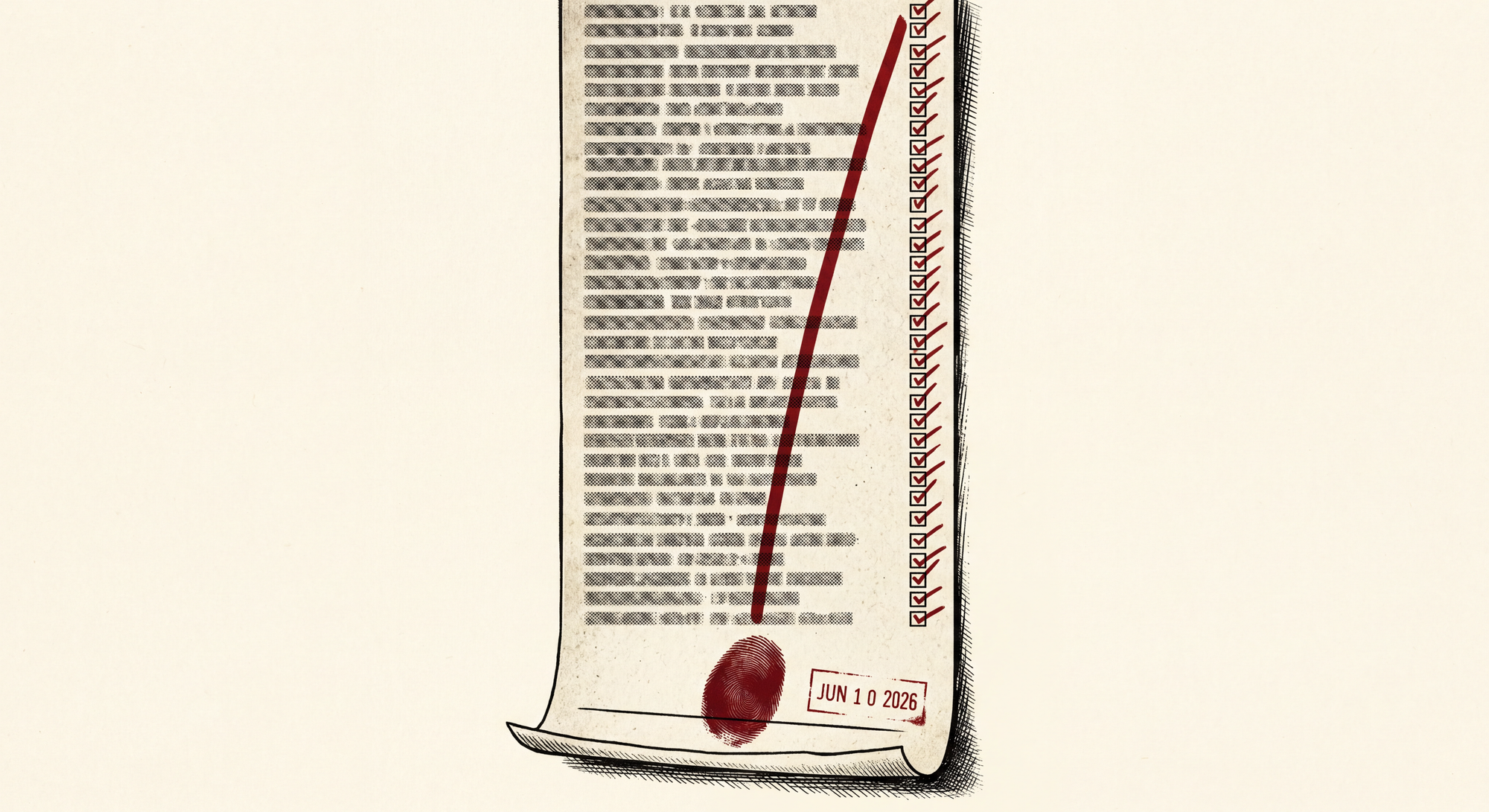
Nobody voted for the control system. It was ratified one checkbox at a time. The signature at the bottom is yours.
0. This morning, before your coffee finished brewing, you agreed to things you will never read.
Your phone reported your location before your feet hit the floor. Your watch filed your heart rate and your sleep, scored both, and forwarded the shape of you to companies you could not name under oath. Your car, if it’s newer than about 2020, noted when you left, how hard you braked at the end of your street, whether you used your blinker, and depending on fine print you have never seen, may have offered that record to a data broker who offered it to your insurer. Your neighbor’s doorbell took your picture as you walked past. You didn’t agree to that one. Your neighbor agreed for you.
At work you badged in, which is a timestamp. You opened a laptop, which is a screenshot. You joined a call, which is a transcript. If you work for one of the ten largest private employers in America, the odds are four in five that some part of your day was reduced to a productivity number and attached to your name. In 2022, reporters at The New York Times counted: eight of the ten track individual workers this way. That was four years ago. The tooling has not gotten gentler since.
None of this is exotic. None of it is a forecast. It is a Tuesday.
So here is the question this essay is built on, and I want you to actually answer it before you read another word: when did you vote for any of it?
You didn’t. There was no bill. There was no referendum on whether the doorbell network gets your face, whether your boss gets your keystrokes, whether your car gets to testify against you. Nobody stood on a debate stage and proposed the most complete observation system in human history, and nobody got to vote it down. There was a checkbox, and you were in a hurry.
We all were.
This is an essay about the most controlled society human beings have ever built. It is more granular than East Germany at its worst. It is more complete than any company town. It was assembled in your lifetime, most of it in the last fifteen years, by a few hundred companies and the agencies that buy from them, and it was assembled without force, without a coup, without a single shot or a single law that named what it was building.
And here is the part you are going to struggle with, because I struggled with it, and I am not going to let either of us off the hook: nobody did this to you. At every fork in the road, you were asked. The asking was rigged, and we will spend a few thousand words on exactly how. But the signature is real. It’s on every page. It is being entered into evidence, right now, as consent.
Mine too.
Three questions, in order. What was built. How your yes was purchased. And what your kids inherit if the curve holds. The last one ends at a mirror, because the mirror is where this argument has always been headed.
I. The Watched Floor
Start where most adults spend most of their waking hours: at work.
In May 2026, Meta laid off roughly 8,000 people, about a tenth of its workforce, and in the same season switched on an internal monitoring program for the people who were left. No opt-out. More than a thousand employees signed a petition against it. Workers in the UK started a union drive over it. The program stayed. Mark Zuckerberg defended it personally.
Hold that image, because it is the cleanest articulation of the modern workplace anyone has produced: the survivors of a layoff, working under surveillance that they formally protested and could not refuse, generating the data that trains the systems coming for the rest of their jobs. Watched while afraid. That is not a dystopian short story. That is a Fortune 10 company in the second quarter of 2026.
Meta is not an outlier; Meta is just legible. Amazon mounted AI cameras in its delivery vans in 2021. They watch the driver, not just the road, and they grade him. The same company tracks warehouse workers by “time off task,” measured in minutes, compiled automatically, fireable at thresholds the worker doesn’t set. Call centers run sentiment analysis on their agents’ voices in real time. Software sold openly, with its own trade-show circuit, takes webcam shots of remote workers at random intervals to verify the human is in the chair. The trade press calls this “workforce analytics.” The people under it call it what it is.
Here’s what matters for the argument: not one of these systems was legislated. No Congress weighed the question of whether an employer may algorithmically grade the second-by-second behavior of a human being. It arrived as a procurement decision, department by department, vendor contract by vendor contract. The most consequential workplace-rights rollback in a century has no law attached to it that you could point to, protest, or repeal. There is nothing to repeal. There are only terms of employment, and you agreed to them, because the job was the job.
And one state finally did write a law about the fairness of the algorithms doing the hiring and firing. One law. Narrow. Polite. Watch what happened to it. That story is coming in section III, and it’s worse than you think.
II. The Watched Street
Now walk outside.
A company called Flock Safety sells automated license-plate readers to police departments, homeowners’ associations, and shopping centers. By the mid-2020s its cameras were operating in thousands of American communities, and by the company’s own count its network was logging billions of plate scans a month: where your car was, when, photographed, time-stamped, searchable. Nobody voted for a national vehicle-tracking grid. No legislature would have dared propose one. It was sold, HOA by HOA, strip mall by strip mall, at a few thousand dollars a camera, and assembled itself into exactly the thing no legislature would have dared propose.
Ring did the same thing for faces. At its peak, Amazon’s doorbell subsidiary maintained partnerships with more than two thousand police and fire departments, complete with a portal where officers could request residents’ footage. Each individual doorbell was a private purchase. A reasonable one. You wanted to see who was at the door; you’d had a package stolen; the camera was ninety-nine bucks. The network those reasonable purchases added up to is a privately owned, publicly accessible surveillance mesh covering the residential streets of the United States, built at the residents’ own expense, mounted by their own hands.
Read that again, because it’s the mechanism this whole essay turns on: the most extensive camera network in American history was not installed by the government. It was installed by the neighbors, voluntarily, and they paid for the privilege.
Your car joined the network when you weren’t looking. In 2024, a reporter at The New York Times caught General Motors enrolling drivers in a program called Smart Driver, many of them without realizing it, and feeding their braking, acceleration, and speed data to a broker, which fed it to insurers, who raised people’s rates. When the story broke, GM apologized and shut the pipeline down. Note the order of operations. The apology was not for the collection. The apology was for the headline. The sensors are still in the cars. Every automaker has them now. The capability didn’t go anywhere; it never does.
And if you’re poor, the car doesn’t just watch you. It obeys someone else. By 2014, lenders had installed remote starter-interrupt devices in roughly two million American vehicles on subprime auto loans. Miss a payment, and the car won’t start in the morning. The repo man has been replaced by a packet. There are documented cases of cars disabled with children in them, disabled in traffic lanes, disabled when a borrower was three days late. This is not a pilot program or a patent filing. This is a standard, decade-old feature of being broke in America: machinery you paid for that answers to your creditor first and you second.
One more, because it completes the set. The Supreme Court ruled in 2018 that the government generally needs a warrant to track your phone’s location history. So federal agencies simply bought the same location data from commercial brokers, no warrant required. Homeland Security, the IRS, the Defense Intelligence Agency, by their own eventual admissions. You had already consented to the collection somewhere in the terms of a weather app.
The Fourth Amendment has a checkout page.
III. The State Is a Customer
You might expect, at this point in the story, that government would be the counterweight. The referee. That is the civics-class model: industry builds, the state restrains.
Look at the record of the last eighteen months and tell me which direction the restraint is flowing.
On January 21, 2025, the day after the inauguration, a sitting president stood in the Roosevelt Room beside the CEOs of OpenAI, Oracle, and SoftBank and personally announced their five-hundred-billion-dollar private AI infrastructure venture. The state’s blessing was the launch event. Nobody voted on it. Nobody voted on any of the sites that followed, in Texas and New Mexico and Ohio and Michigan, or on the five-gigawatt campus co-branded with a foreign sovereign wealth fund.
In August 2025, the federal government cut a deal making ChatGPT available to every federal agency for one dollar per agency per year. Four months later Google undercut it: Gemini at forty-seven cents. A federal workforce of more than two million people is being trained, right now, to run the people’s business through two private platforms priced like bait, because that is what the pricing is. You do not sell a product to the United States government for a dollar. You acquire a dependency. Once an agency’s workflows, prompts, and institutional memory live inside one company’s model, the switching cost does the rest. This is the platform playbook that captured your photos and your friendships, pointed at the federal workforce, and it is working.
Then there’s Colorado, which deserves to be told slowly.
Colorado passed the first real law in America governing algorithmic decisions about workers: a statute requiring companies to use reasonable care that the AI systems making hiring and firing decisions don’t discriminate. Reasonable care. That was the whole ask. It was scheduled to take effect June 30, 2026.
Elon Musk’s xAI sued to kill it. In April, the United States Department of Justice joined the suit. The federal government, intervening on the side of the world’s richest man, against a state law about fairness in firing. Within weeks, a federal court suspended the statute. On May 14, the governor signed the repeal. The replacement is disclosure-only and doesn’t even pretend to start until 2027.
The first rule in the country that asked an algorithm to be fair before it fired you died forty-seven days before it would have existed.
Three weeks later, on June 4, a bipartisan pair in the House released a 270-page draft called the Great American AI Act, which would freeze state AI-development laws nationwide for three years. It was the third attempt in twelve months to shut down the states, after the Senate stripped a ten-year version from the budget bill 99 to 1. The draft’s authors swear states will keep their power over how AI is used. Colorado’s dead law was a use law. The same coalition killed it anyway, in court, that spring. The assurance at the center of the bargain was broken before it was offered.
The presidents of the teachers’ union and the flight attendants’ union read the draft and issued a joint review that opened with two words: “Hard no.” They called it “a giveaway to the AI industry and a handful of trillion-dollar companies, at the expense of American workers,” and they named what the freeze would actually strip from the states: the power to stop algorithmic firing, automated wage manipulation, and AI-enabled surveillance of workers. One organization welcomed the draft warmly the same week: the Information Technology Industry Council. Big Tech’s own trade group. When labor says no and the lobby says yes inside the same news cycle, you don’t need a decoder ring to know who held the pen.
And in February 2026, the arrangement showed its teeth from the other side. Anthropic, an AI company whose terms of service prohibited using its models for autonomous weapons and mass domestic surveillance, refused the Pentagon’s demand to drop those restrictions. The Pentagon designated it a “supply chain risk,” a label built for foreign adversaries. An American company was blacklisted by its own government for declining to let its product surveil Americans en masse.
Add it up. The state is not regulating this system. The state is a customer of this system, a co-investor in this system, and increasingly a sales rep for this system: suing its own states on the industry’s behalf, punishing the one vendor that kept a conscience clause. Whatever you learned in civics about who checks whom, update it. The referee bought a jersey.
IV. Citizen, User
Here is the deepest change, the one underneath all the others, and it can be said in two sentences.
A citizen has rights. A user has permissions.
Rights are yours until a court takes them, slowly, in public, with appeals. Permissions are the company’s until a product manager changes them, instantly, in private, with a changelog nobody reads. Over about twenty years, without ever announcing it, America migrated most of daily life from the first category to the second: speech to platforms, commerce to marketplaces, navigation to maps that watch you back, friendship to feeds, work to dashboards, the front door to a subscription. Each migration came with a document, and every one of those documents says some version of the same sentence, the most important sentence in modern law: we may modify these terms at any time.
Think about what that sentence is. It is a social contract with a unilateral amendment clause. Hobbes and Locke spent their lives arguing over what men surrender to the sovereign and what the sovereign owes back. The new sovereigns solved the problem by reserving the right to edit the deal after you’ve signed it, forever, while you sleep.
If you think the fine print is harmless boilerplate, consider how confident its authors have become. In 2024, lawyers for the Walt Disney Company argued in a Florida court that a man could not sue over his wife’s death, an allergic reaction after a meal at a restaurant on Disney property, because he had once signed up for a free trial of Disney+, and the streaming app’s terms contained an arbitration clause. Disney backed down when the story went public. But look hard at the argument itself, because the argument is the receipt: professionals at one of the largest companies on Earth looked at a widower, looked at a checkbox he’d clicked years earlier to watch television, and concluded in writing that the checkbox outranked his day in court. They weren’t being absurd. They were being fluent. They understood, better than the rest of us, what the checkbox has become.
That’s the architecture. A watched floor, a watched street, a watched car; a state that buys in rather than referees; and a legal layer that converted citizens into users one agreement at a time. No villain built it. No parliament approved it. It is the largest transfer of practical power in the modern era, and it was executed entirely in documents nobody reads, ratified entirely by people in a hurry.
Which raises the only question left worth asking. Why did we sign?
V. The Town With a Visible Fence
In the 1880s, George Pullman built a town on the prairie south of Chicago and named it after himself.
It was, by the standards of the day, a marvel. Brick houses with indoor plumbing, a market, a library, a church, parks, gas lighting, all of it owned by the Pullman Palace Car Company, all of it leased to the workers who built the sleeping cars. The company set the rents and deducted them from wages. The company decided what could be sold in the shops, what could be said in the meeting halls, which books the library carried. Company inspectors could enter your home. There were no saloons, because Mr. Pullman disapproved, and there were no elected officials, because the town wasn’t a municipality. It was a product.
One worker summed up his life there in a sentence that survived him by a century: “We are born in a Pullman house, fed from the Pullman shops, taught in the Pullman school, catechized in the Pullman church, and when we die we shall go to the Pullman Hell.”
In 1893 the economy turned, and Pullman did what the spreadsheet said: cut wages roughly a quarter while holding rents exactly where they were, since rents were a separate line of business. The workers noticed they were being squeezed at both ends by the same hand. In 1894 they struck, the railway union honored the boycott, the federal government sent troops to break it, men died, and the strike’s leader went to prison. The Supreme Court of Illinois eventually forced the company to sell the town. American labor law spent the next half-century being written, in part, in the shadow of what Pullman proved: that a company which controls your wage, your rent, your store, your news, and your church does not have employees. It has subjects.
Now, the reason I’m telling you a story you half-remember from a high-school textbook.
Every man in Pullman, Illinois, could see the fence. The town had edges. The company had a name, and the name was on the water tower. A worker who walked far enough reached a street where Pullman’s writ ran out, and he knew exactly when he’d crossed it. The control was total, but it was legible. Because it was legible, it could be hated, organized against, struck against, litigated against, and finally broken. It took a depression, a dead man’s railroad, federal troops, and the courts, but the visible fence came down.
The new company town has no fence, because it has no edges, because it is not a place. It’s in your pocket. Its housing is your feed, its store is your checkout, its church is your for-you page, and its inspectors don’t knock because they’re already inside. Its scrip is being beta-tested right now. Hold that thought, because we are coming back to scrip. You cannot walk out of this town, not because the gate is locked, but because there is no out. The geography that made Pullman beatable has been deleted.
And there is one more difference, the one that matters most. Pullman’s subjects resented the arrangement from the first day, because nobody pretends a company inspector in your kitchen is a gift. Our arrangement arrives gift-wrapped. Which brings us to the actual mechanism.
VI. The Coupon
Every control system in history has had the same bottleneck: enforcement is expensive.
East Germany ran the most thorough surveillance state of the analog era, and the price was ruinous. At the end, the Stasi employed about 91,000 full-time officers and ran a registered-informant network of roughly another 180,000, call it one watcher for every sixty citizens, plus the file rooms, the steam-openers for the mail, the men in parked cars. It devoured the national budget and corroded every human relationship in the country, and it still leaked. Total control, it turned out, costs more than total control produces. That was the great consolation of the twentieth century: the boot was unaffordable at scale.
The discovery of our era is that the boot was never necessary. And I mean discovery, in the way the steam engine was a discovery: the kind that reorders everything downstream of it.
A coupon works.
Nobody had to force the tracker into your pocket; it plays music, so you bought it. Nobody installed the microphone in your kitchen; it sets timers, so you asked for one for Christmas. Nobody mounted the camera on your front door; you did, for $99 plus subscription, because the porch pirates were getting brazen. The insurance company didn’t demand the right to monitor your driving; it offered you a safe-driver discount, which is the same sentence with a bow on it. Your employer didn’t seize your location; the badge does double duty as the parking pass. The store didn’t confiscate cash; it just made the app fifteen seconds faster, and the line was long.
Stasi math: one watcher per sixty citizens, at state expense, and the system bled money until the state collapsed.
Our math: several watchers per citizen, at the citizen’s own expense, generating profit at every layer.
The twentieth century’s tyrannies paid for surveillance. The twenty-first century’s surveillance pays for itself, and the watched party covers the hardware. If you brought that business model to the ghost of any secret policeman in history, he would assume you were mocking him. A population that buys its own telescreens? That upgrades them annually? That reviews them? Five stars. Works great. Baby slept through the night.
This is why I keep insisting the word consent stay in the middle of the table, as uncomfortable as it is. Because each individual transaction really was voluntary, and each one really was, in isolation, a good deal. The camera did catch the package thief. The app is faster. The discount is real, this quarter anyway. You were not defrauded item by item. You were defeated in the aggregate, by a system that learned to decompose total control into ten thousand reasonable purchases, none of which, on its own, was worth fighting about.
The fence didn’t come down. It was bought, plank by plank, by the people inside it. And every plank made sense at the time.
VII. The Scandals That Changed Nothing
If you doubt that the purchase is complete, look at what happens when the curtain slips. We have run this experiment, at national scale, at least three times. The results came back identical.
June 2013. Edward Snowden hands journalists documentary proof that the United States government is collecting the phone records and digital traffic of essentially everyone, including its own citizens, with the cooperation of the major platforms. It is the largest disclosure of domestic surveillance in American history. There are hearings. There is one significant statutory adjustment to one program. And then everything resumes its prior curve: traffic, sign-ups, screen time, the platforms’ market caps. The country learned, definitively, that it was being watched, and the country’s behavior changed by approximately zero.
June 2014. Researchers publish a study in the Proceedings of the National Academy of Sciences revealing that Facebook had deliberately manipulated the emotional content of 689,003 users’ news feeds, suppressing positive posts for some and negative for others, to see whether it could make people measurably sadder or happier without their knowledge. It could. No one was asked. The paper called it “emotional contagion.” The outrage lasted about a week. I want the number itself to stay with you. Not the 689,003. The week.
March 2018. The Cambridge Analytica story breaks: psychological profiles harvested from as many as 87 million Facebook accounts, deployed for political targeting. “Delete Facebook” trends. On Facebook. Congress summons Zuckerberg, senators ask him how the company makes money, he says, with the smile of a man realizing the inspection is over, “Senator, we run ads.” Facebook closes the year with record revenue and more users than it started with.
Three exposures. Surveillance by the state, manipulation by the platform, exfiltration by third parties: the full taxonomy of what can be done to a watched population. Each one proven beyond dispute. Each one absorbed without consequence. The system did not survive these scandals by hiding. It survived them in the open.
You can read that record as proof that people are sheep. I don’t, and the punching-down reading misses the actual finding. People made a rational calculation, three separate times, and it came out the same way: the thing I would have to give up is my whole connected life, and the thing I would gain is a privacy I can no longer even picture. Outrage was free, so we spent plenty of it. Refusal had a price, so we checked the tag, and we put it back on the shelf.
Which means if you want to understand what has actually happened to freedom in our lifetimes, you have to stop watching the scandals and start watching the price tag. So let’s do that, precisely.
VIII. The Price of Refusal
Forget, for a minute, every definition of freedom you’ve been given that involves what you are allowed to do. Practically nothing is forbidden to you. You may, in 2026, in America, legally live without a smartphone, decline every platform, pay cash, drive a dumb car, and keep your face out of every database that will let you. No statute stops you. The Bill of Rights is intact on paper.
Now price it.
No smartphone: you’ve surrendered two-factor authentication, which means half your accounts; mobile boarding passes; the parking apps that have replaced meters in most cities; the QR menu; the school’s pickup-notification system; the gig economy in its entirety; and, increasingly, the job application itself. No platforms: you’ve left every group chat where your friendships actually live, the marketplace where your town actually sells things, the feed where your trade actually advertises. Cash: fine at the diner, useless on the toll road that no longer has a booth, impossible at the stadium and the airport kiosk and the parking garage that went “contactless only” during the pandemic and never went back. Dumb car: they stopped making them. Try buying a new vehicle in America without a modem in it. The salesman will look at you like you asked for a carburetor. Face out of the databases: your state DMV would like a word, and so would your neighbor’s doorbell, which, as we established, never asked you.
Total it up. The price of full refusal in 2026 is, give or take: your employability, your social existence, your mobility, and your standing as a regular customer of the economy. Not your liberty. Nobody arrests you. You’re free to refuse, exactly the way you’re free to live in the woods.
Now run the same audit on earlier decades, because the trend line is the argument. In 1995, the price of refusing the network was zero. The network was a hobby. In 2005, it cost you some convenience and a little social standing; you were the friend people had to call. In 2015, it cost you real friction, the boarding pass and the group chat and the early bossware, but a determined adult could pay it and hold a normal life together. In 2026 the cost is a different category: not friction, but exclusion. And the systems being installed right now set the 2035 price. Work mediated by platforms. Pay calculated by models. Identity verified by biometrics. Money going programmable. That price is where this essay is headed, and I will tell you now that it is not a number a working person can pay.
That is the chart that matters. Not what’s banned. Nothing’s banned. What it costs to say no, decade over decade. It is the only honest measure of freedom left, and it has never once bent downward, and no legislature ever voted on a single increment of its rise.
A prohibition you can see, name, and fight. A price just sits there, climbing a little every year, presenting itself as the weather. But somebody sets every price. The weather is manufactured.
Which leaves one honest question hanging over all of this. If the price of refusal climbs every year, and the scandals proved what the system is, why doesn’t it feel like that? Why doesn’t a society this watched feel watched?
Because the system holds two patents, not one. The second is anesthetic.
IX. Soma With Telemetry
For seventy years, people who worried about the future argued over which prophet had it right.
Orwell said control would come as pain: the boot, the camera, the Ministry, the fear. Huxley said it would come as pleasure: nobody would need to ban books in a society that couldn’t be bothered to read one, and the cage would be carpeted, and the prisoners would defend it. Neil Postman split the difference in 1985, in a foreword most people know better than the book it opens: Orwell feared what we hate would ruin us; Huxley feared what we love would. Postman, watching television eat American discourse, scored it for Huxley.
He was right, and he undersold it, because he died before he could see the two prophecies merge into a single product. That’s what’s in your pocket: Huxley’s interface running on Orwell’s database. The front end is soma. The feed, tuned by the most sophisticated behavioral machinery ever built to the exact grain of what you cannot look away from, soaking up what is now, by most estimates, north of seven waking hours of the average American day. The back end is the telescreen. Every scroll, pause, hover, and 2 a.m. search, recorded, scored, retained. One hand soothes while the other writes everything down. The elegance of the pairing is that the soothing hand controls your attention, and the things you cannot look away from are never, somehow, the things being done to you. Orwell needed a Ministry of Truth working three shifts. The feed needs no censor at all; it just needs your outrage aimed somewhere profitable, and it has a dial for that.
And the watching half does its work even when no one acts on it. Especially when no one acts on it. This is the oldest design note in the literature: when Jeremy Bentham drew up his panopticon in the 1780s, the entire point of the architecture was that the guard tower didn’t need a guard. The prisoner who might be watched polices himself, around the clock, free of charge. Self-censorship is the cheapest enforcement mechanism ever devised, and we have receipts that it’s running. After the Snowden disclosures, researchers documented a sharp, sustained drop, on the order of a fifth to a quarter, in traffic to Wikipedia articles on sensitive, terrorism-adjacent topics. Mark what that is. Americans did not stop doing anything; they stopped reading. Stopped looking things up. The mere confirmed knowledge of the database was enough to make a free people quietly trim their own curiosity to fit what they imagined the watchers might think. Perfectly legal curiosity. Encyclopedia curiosity.
Nobody ordered that. No memo went out. That’s the trick of the whole apparatus: the boot produces resistance, but the tower produces self-management, millions of people sanding their own edges down, just in case, while the feed keeps the sanding painless. We built Bentham’s tower at planetary scale, put a like button on it, and moved in voluntarily.
So no, it doesn’t feel like control. It was never going to. Feeling it would be a design defect, and these are very good engineers.
X. The Vocabulary
No control system survives on hardware alone. It needs language. Specifically, it needs language that makes the cage sound like a concierge. Once you learn to hear it, you can’t stop, so consider this section a small act of sabotage.
Start with the flagship. Personalized means profiled. There is no second meaning. Frictionless means unexamined, because friction is where a person stops and thinks, and stopping to think is the behavior being engineered out. From there the dictionary writes itself, once you hold the key: a smart device is a device that reports you, and you are the thing it’s smart about; safety, in a product launch, is surveillance you’ll thank them for; your community guidelines are speech laws for three billion people, written by no legislature, appealable to no one, maintained the way a chain restaurant maintains a menu. My personal favorite is the safe-driver discount, which is a wiretap with a rebate. And the genre keeps producing. Dynamic pricing arrived a few years ago; it means the price was calculated against you, personally, from your history, your zip code, your battery level. When a company announces it is becoming AI-native, as Coinbase did in the same month as its layoffs, run the translation: a layoff, rebranded as an upgrade.
The workplace dialect is its own genre. A boss who calls workers human capital is telling you what the spreadsheet already believes; nobody gets called human capital until they’re about to be cut, and the CEO of Standard Chartered proved it in 2026 by apologizing for the phrase “lower-value human capital” while leaving the cuts it described fully on schedule. The apology got media-trained. The plan didn’t. NVIDIA’s Jensen Huang says AI will “redistribute job content.” Redistribution has a direction. It points away from the floor. Amazon’s robotics chief, Tye Brady, says he wants to “eliminate every menial, mundane and repetitive job out there,” a sentence in which somebody else’s mortgage is hiding inside the word menial. And every deployment, everywhere, is assistive. Support is the word every replacement wears on the way in.
This vocabulary is not decoration. It is the consent-manufacturing layer, the reason the checkbox feels light. You were never once asked, “May we build a continuous behavioral record of you and sell access to it?” You were asked if you wanted a smarter, safer, more personalized experience. Of course you said yes. The sentence was engineered to be said yes to. Whole books have been written on manufactured consent. The operational summary fits in a sentence: control the verbs, and the checkboxes check themselves.
George Orwell told you this part. People quote him on the cameras and miss that his real subject was the dictionary.
XI. The Scrip Comes Back
One thread left from Pullman, and it’s the one that should worry you most, because it’s the one aimed at the paycheck.
Pullman partly paid his workers in scrip: credit redeemable at the company store, at the company’s prices. The trick wasn’t the store. The trick was that the wage and the cost of living were set by the same hand, so the company could give with one and take with the other, and the worker could never quite tell what he actually earned. It was outlawed, eventually, alongside the rest of the company-town toolkit, because lawmakers a century ago understood something we’ve let slip: a wage you can’t inspect is not a wage. It’s an allowance.
Now look at how the platform economy pays.
The legal scholar Veena Dubal spent years studying gig-platform pay and gave the pattern a name: algorithmic wage discrimination. Drivers doing identical work, in the same city, at the same hour, are offered different pay, calculated per person from data: your acceptance history, your habits, what you’ve taken before, what the model estimates is the minimum that keeps you specifically logging in tonight. The wage isn’t a rate anymore. It’s a personalized behavioral lever, recalculated continuously, disclosed to no one. Economists once had a word for paying different people differently for the same work, and it was not optimization.
This is scrip, rebuilt. Pullman could only set one rent and one wage for the whole town; the model sets a private wage for every worker, every shift, tuned to each worker’s desperation, and the worker, exactly like Pullman’s, can never quite tell what he actually earns, because there is no rate card to check it against. The company store has been replaced by something better: a store that prices you dynamically too. Wage personalized downward, prices personalized upward, both by parties who know your bank balance better than you do. The squeeze Pullman ran at town scale now runs at the scale of one. Which is to say, perfectly.
And here is where the Pullman threads tie off into a single knot. When the unions read the Great American AI Act, the three-year freeze from section III, they named, specifically, what states would be barred from stopping: algorithmic firing, AI-enabled surveillance of workers, and automated wage manipulation. The scrip is back, it has a lobby, and the bill on the table in Washington this month would make it none of the states’ business until 2029.
The nineteenth century needed forty years, a depression, and federal troops in the streets to decide that a company may not be your employer, your landlord, your grocer, your banker, and your government at once. We are reassembling that exact arrangement, wage and prices and credit and speech and identity all administered by the same few hands, except this time the town has no edges, the scrip is an API, and the inspectors never sleep.
Pullman’s workers had one advantage over you. Nobody ever asked them to click agree. They could see, every morning, the name on the water tower. They knew they hadn’t chosen it.
You won’t have that. You have the receipts.
Which is the problem with what comes next, because what comes next is about who inherits them.
XII. Walking the Slope
Prophecy is cheap, so let me be clear about the method before I spend the rest of this essay on the future. I am not going to tell you what I feel is coming. I am going to take systems that are already deployed, already funded, already on the record, receipts rather than vibes, and walk each one forward at its current slope. No miracles required in either direction. If anything below sounds like science fiction to you, the citation is upstream in this essay, operating today.
Here is what the slope delivers, somewhere in the middle 2030s, to a young American entering the workforce.
She applies for work through a model. Not “submits a résumé that a model screens.” Applies through it: the posting written by one system, her application parsed by another, the interview conducted by software that scores her word choice, her face, the milliseconds she hesitates. Whether any of those systems carries a bias against her accent or her credit history or her zip code, no one will be obligated to check. The one American law that required anyone to verify the machine’s fairness before it pulled the trigger died in the spring of 2026, forty-seven days before taking effect, sued to death by the richest man alive with the Justice Department riding shotgun. Nothing in the 270 pages Washington offered in its place requires a single fairness test. Disclosure duties, not conduct duties. Publish a framework; report an incident. The machine aimed at her job owes her nothing but a privacy policy.
If she’s hired, a model schedules her: shifts assembled from demand forecasts, posted at algorithmic notice. A model sets her pay, individually, the scrip-logic of section XI now standard across the service economy because nothing stopped it during the freeze. A model watches her work. By 2026 that was already the standard at four of every five of the biggest employers; assume saturation. And a model weighs her output against the robot across the floor, whose cost curve only bends down. The robot is not hypothetical either. The year she was in middle school, Figure’s machines ran a 24-hour shift sorting 28,000 packages with zero humans present, the company was building a robot an hour at its first plant, a German parts maker announced plans for humanoids by the thousand without announcing one new hire to run them, and a six-foot humanoid went on general sale in October like a dishwasher. Bank of America’s analysts were projecting more than a million humanoids by 2030. Her performance review has a price floor under it, and the floor is the lease rate on her replacement.
When a model finally decides against her, and the decision will be phrased as her metrics even though it was made by the comparison, the layoff will be blamed on AI in the press release and on nothing at all in the legal filing. We know, because that’s already the pattern. The year before this essay, New York required employers to check a box if AI drove a layoff. 162 notices were filed. Zero boxes were checked. By May 2026, AI was the number-one stated reason for American job cuts, with nearly 88,000 blamed on it by June, and simultaneously, somehow, the legal reason for almost none of them. The machine takes the credit, the worker takes the email, the form takes the silence.
She is paid into an account, because cash, by then, has finished the long exit it began at the toll booth and the stadium. Not banned. Remember, nothing is banned. Just declined, surface by surface, until carrying it marks you as a problem. Her money is programmable, which is sold to her, correctly, as protection against fraud, and which also means, structurally, that her money has permissions instead of value: it can be conditioned, geofenced, expired, frozen, by whoever administers the rails, public or private, on terms amendable at any time. And her identity runs through biometrics: for work, for payments, for proving she’s a human on an internet full of synthetics. Perhaps through the iris-scanning orb that the man whose company displaced her built as a side project, having migrated, in his own words across five short years, from the state should tax us and pay you to a payout you collect through his own apparatus. The eyeball scan will not be mandatory. It will simply be the only door that isn’t slow.
Add it together and name it honestly. Hired by a model, scheduled by a model, paid by a model, watched by a model, priced by a model, fired by a model, banked on rails with permissions, identified by her body. Every system owned by roughly ten companies, governed by terms she cannot negotiate, amendable while she sleeps. There is a phrase for a society like that, and we’ve been using it all along about other countries. We mock China’s social credit system, mostly inaccurately, as a cartoon of centralized control. Meanwhile we are assembling something more sophisticated than the cartoon, decentralized and redundant and privately operated and profitable, and calling it customer experience.
And here is the detail I cannot put down, the one I think about at night. I have a daughter. She’ll come of age inside this. She will never have done an unobserved thing. Not one walk, not one purchase, not one sentence typed and deleted. So she will not miss what she never touched. The freedom this essay is trying to point at will not feel, to her, like a loss. It will feel like my grandfather’s stories about riding in truck beds: charming, vaguely irresponsible, not applicable. That’s the part that gets me. Not that she’ll be watched. That she won’t be able to imagine not being, because the watching will have been the water she swam in since the doorbell first logged her stroller.
The East Germans, at least, knew. One watcher per sixty citizens, and every citizen could feel the eyes; the fear was the system working. My daughter will carry a better informant than the Stasi ever recruited in her own pocket, paid for out of her own paycheck, reviewed five stars. And she will feel nothing at all. The control system perfected is not the one you fear. It’s the one you’d miss.
And if you think I’m guessing about how she gets acclimated, I’m not. The acclimation program is already running. It has a budget line in your school district.
XIII. The Practice Generation
Everything in this essay so far has carried one fig leaf: the checkbox. However rigged the asking was, an adult was at least nominally asked. There is exactly one place in American life where the system drops the consent theater entirely. You could not write this as fiction. It’s the schools.
A child in an American public school today is very likely working on a district-issued device running monitoring software with a name like Gaggle or GoGuardian or Securly. By the early 2020s, surveys of teachers put school adoption of this software at four schools in five, and the vendors themselves advertise scanning billions of student items a year: every essay draft, every email, every search, every chat on a school account, read by classifiers hunting for keywords, with flags routed to administrators and, in more districts than will admit it, directly to police. The stated purpose is safety, and sometimes it is even served. The operational reality is that an eight-year-old’s rough drafts are read by software that can summon an adult with handcuffs, and the eight-year-old knows it, the way kids always know.
It doesn’t stop at the document scan. There are vape sensors in the bathrooms and aggression-detecting microphones in some hallways. There are digital hall passes that time how long a teenager spends at the toilet and flag the ones who go too often. There are attendance apps that ping their phones, camera systems sold with face recognition as an upgrade option, and, by the time she reaches college, proctoring software that watches her through her own webcam during exams and files a suspicion report if her eyes leave the screen too long. Look away from your own screen too long: suspicion. That is a real product, in real universities, grading the gaze of legal adults who paid to be there.
Set aside, for one minute, whether each tool is justified. That argument is the trap, because each tool always has a story, the way each camera and each coupon always had a story. Look instead at the curriculum underneath. A kid who passes through this system learns, years before anyone hands her a civics textbook with the Fourth Amendment in it, a complete and internally consistent set of lessons: that everything she writes is read by something; that the reading is for her own good; that the bathroom has a timer; that flags go on a record; that the gaze itself is graded; and that none of this is anyone’s decision. It’s just school, the way it’s just work, the way it’s just the app. Nobody asked her, and nobody had to pretend to, because she’s a minor. Her consent is the one kind the system never even bothers to manufacture. It’s simply administered, on her behalf, by adults who clicked agree on her future without reading it, the same way we click everything.
Our generation, the checkbox generation, at least clicked. Hers won’t get a box. They get the defaults, pre-installed, in third grade, and a childhood of practice at being legible to machines.
Every control system in history has needed one thing it could not build with money: a cohort that has never known otherwise, for whom the apparatus isn’t an imposition but a birthright. The water, not the fence. Ours is in fourth grade. The system isn’t waiting for them to grow up. It’s raising them.
XIV. No Villain Required
Now the claim that makes all of this prophecy rather than mood, and I want to state it with some precision, because it’s the load-bearing beam.
None of what I just described requires a villain. That is what makes the forecast reliable.
Conspiracies are fragile. They need secrecy, coordination, and discipline, and they get caught, because somebody always talks. What we have instead is sturdier: several hundred companies, each independently optimizing for engagement, retention, margin, and quarterly guidance, discovering one by one that data is margin and control of the customer is retention and fewer humans is guidance you can hit. Nobody needs to convene. The incentive convenes them. Seven CEOs reach the same answer independently because the structure only allows one answer if you’re the one selling it. I’ve made that argument elsewhere about the abundance pitch. It holds here, downstream, for the control stack too. You do not need them coordinating to understand why they rhyme.
This is why every fix that assumes a villain keeps failing. Fire the CEO: the successor faces the same spreadsheet. Break one company: the practices are industry-standard within the decade. Pass a scandal-driven law: it regulates the last scandal’s mechanics while the next one ships. The system is not a plan; it’s a gradient, and everything on it rolls the same direction without anyone pushing. A quarterly target does not get caught, does not defect, does not have a deathbed conscience, and does not retire. The villain theory is actually the comforting story, because villains can be deposed. A gradient just sits there, patient as gravity, delivering the future one sensible product decision at a time.
So when I tell you where this goes, I’m not predicting that bad men will seize the apparatus. Though note that the apparatus now exists, fully assembled, awaiting whoever wins it, and that should bother you on its own: we built the turnkey state, and we’re holding elections over the key. I’m predicting something duller and far more certain: that absent organized resistance, every system above gets one notch tighter per product cycle, forever, because each notch clears its business case. The most controlled society in history will not be commanded into existence. It will be shipped. It is being shipped now, feature by feature, sprint by sprint, by tens of thousands of decent people who love their kids and hit their quarterly goals, not one of whom has ever once been asked to vote on the sum of what they’re building.
Nobody will declare it, and so there will be no date to mark, no wall going up, no morning when the tanks are in the square. There will just be a decade where the price of refusal quietly crossed the line from expensive to unpayable, and after that, the consent will be retroactive, the way it already is for the doorbell, the badge, the feed, the score.
That’s the prophecy. Hold it next to the receipts and tell me which part is speculative. The slope is the villain. We’re standing on it.
XV. The Mirror
Here’s the exercise this essay has been walking toward. I’m asking you to actually do it, not nod at it.
Try to withdraw your consent for seven days.
Not forever. Nobody’s asking you to homestead. One week. No products from the surveillance economy you can avoid: phone in a drawer, or stripped to calls. No feeds. No assistant in the kitchen. Cash where cash still works; find out where it doesn’t, and keep a list. Cover the laptop camera at work and see if anybody emails. Drive without the app watching, if your car still permits such a thing. Decline, for one week, every agree you can decline.
You will fail by Wednesday. I want to be honest with you: I have set versions of this challenge for myself, a man who writes thousands of words under a banner that says Stay Human, and I fail it on schedule. The two-factor prompt got me by Tuesday. The bank requires the phone, and the mortgage doesn’t pause for principle.
But the point of the exercise was never to pass. The point is the list. Write down everything that broke: every door that wouldn’t open, every transaction that died, every relationship that went quiet, every work obligation you couldn’t meet, every minute of friction. That list is not an inconvenience inventory. That list is a ledger: it is the precise, itemized, denominated record of how much of your life has already been transferred into systems you do not control and cannot inspect. Not metaphorically. Arithmetically. You have just measured the fence Pullman’s workers could see. Except you had to go looking for yours, because it was built to be invisible from the inside.
And while you’re failing the week, you’ll discover the system’s deepest lock, the one almost nobody names. You cannot opt out alone. Your neighbor’s doorbell covers your sidewalk whether you like it or not. The group makes its plans in the chat regardless of your principled absence; the plans simply stop including you. Your face attends the cookout in everyone else’s pocket and gets uploaded on everyone else’s terms. The plate readers don’t ask the driver. The school doesn’t ask the kid. Consent, in a networked society, leaks. Everyone else’s yes quietly overwrites your no. The checkbox was always a lie of granularity: it offered you an individual choice about a collective condition. We built the first system in history where opting out requires unanimity. There has never been unanimity about anything. They knew that when they built the checkbox.
Now the last turn of the knife, and then I’ll put it down.
Knowing everything in this essay, the watched floor and the dollar-a-year capture and the dead Colorado law and the scrip and the slope and the list you just made, you would sign it all again. Tonight. So would I. When the update ships and the box appears, we will both tap agree, because dinner needs ordering and the meeting ran long and the kid has practice at six, and refusal costs forty minutes we do not have. That is not a character flaw, and I’m not here to flagellate either of us about it. It’s the design. The system’s one true genius is that it never asks for your freedom all at once, in daylight, where you’d recognize the question and rise to it the way people always have. It asks for Tuesday. Just Tuesday. It has asked for Tuesday a few thousand times now, and it will ask again tomorrow, and the sum of all the Tuesdays is the whole thing: your movements, your wage, your face, your kid’s defaults, handed over freely, signature by signature, by people who were never once defeated, only ever scheduled.
They didn’t take it. You’d know how to fight a taking; your great-grandparents left you the manual. They bought it, from you, in installments, at a price that always looked fair on the day. The receipt has your name on it, and mine, and that is the most uncomfortable sentence I know how to write, so I’ll write it once more, plainly. Nobody surrendered the freest society in history. It was sold, by its owners, one Tuesday at a time, and we are the owners, and the sale is not finished.
Sit with that. Don’t reach for the comfort yet.
Because the comfort is real, but it only works on people who’ve sat with it.
XVI. The Withdrawal
Here’s what the mirror buys you, if you actually look: the end of inevitability, which is the lobby’s favorite word and the only lie in this whole apparatus big enough to matter.
If the control system had been imposed by conquest, by coup, by some genuine villain, then your odds would ride on armies and luck, and history says don’t bet. But that’s not what happened, and you now know it firsthand, because you’ve audited it in your own pocket. It was purchased, from us, in small denominations, with our names on every receipt. And anything consented to in small denominations can be refused in small denominations. The same arithmetic that built it runs in reverse. That’s not a slogan. It’s the actual math, and the receipts of it working are already on the table.
A hundred and sixty thousand actors looked at the synthetic-performer clause and voted 91.4 percent to put a price and an arbitrator between their faces and the machine. Their contract runs to mid-2030, which means the rulebook written at a bargaining table now outlasts the freeze Washington is drafting. The writers did it first, in 2023, and clauses like that get copied. The longshoremen shut the coast in ‘24 and walked away with hard automation language. Two union presidents read a 270-page federal draft and moved the whole fight with two words. In Washington State, as of the morning this essay went up, faking a person’s face is expensive, creator and distributor liable, because a state can still decide your face is yours. Roughly two thousand AI bills are alive in the statehouses right now; the reason there’s a federal bill to freeze them is that they were starting to work. Nobody freezes a thing that’s failing. The freeze is the compliment.
Notice what every one of those wins has in common. Not one came from a CEO’s conscience or a platform’s better nature. Hold the decent-sounding executives with cynicism. Hope, not faith. They are one boardroom away from a different decision. Every win came from people refusing in coordination, which is the one move the checkbox architecture cannot price, because the checkbox was engineered for you alone at 11 p.m., and it has no idea what to do with a local.
So: the withdrawal, in small denominations, this week. Not a manifesto’s worth. A Tuesday’s worth.
Put one analog hour back in your house every evening, phones in the drawer and dinner at the table, not as wellness but as practice. Refusal is a muscle, and it’s atrophied. Pay cash twice this week at businesses that are owned by a person whose name you could learn, and learn it. Decline one default: the assistant you never use, the app the parking sign suggests when the meter still takes coins, the smart upgrade on a thing that worked dumb. Refuse the orb. When the frictionless biometric door and the slow human door stand side by side, take the slow door, on principle, in public, and let your kids see you do it and ask why. If a data center or a plate-reader contract is on your county’s agenda, and check, because it’s on more agendas than you think, show up. The room is usually three retirees and a clipboard, and four changes the math. The federal AI preemption draft is taking public comment at GAAIA@mail.house.gov, and congressional staff weigh a named person in a named trade in a named town over a thousand form letters: write the two paragraphs, say which state protection you are not willing to lose, sign your actual name. And ask the question out loud at work when the new monitoring rolls out. Not a confrontation. A question, on the record, in the meeting: what does it collect, who sees it, can I decline? You will be amazed what one named question does to a room that was counting on silence.
Small. Deliberately small. Because the system is a sum of small, and so is the resistance, and anyone selling you a grander, easier answer is selling you back your own passivity with a logo on it.
The men who wrote this country’s founding paperwork pinned the whole experiment on a phrase: governments deriving their just powers from the consent of the governed. The new governors, the ones with the terms of service and the dollar-a-year contracts and the orbs, skipped the asking, because the asking was the expensive part and they found a workaround. Fine. The doctrine cuts both ways, and it always has. Consent that was never honestly sought can be honestly withdrawn. And withdrawal, unlike outrage, compounds.
You were never asked. That was the theft.
You kept signing anyway. That was the price.
You can stop in increments, starting tonight. That’s the whole fight.
Nobody asked you. Answer anyway.
— Stay Human ★
Get the Dispatch every Sunday.
Free. One issue a week. Forever — until you unsubscribe.