
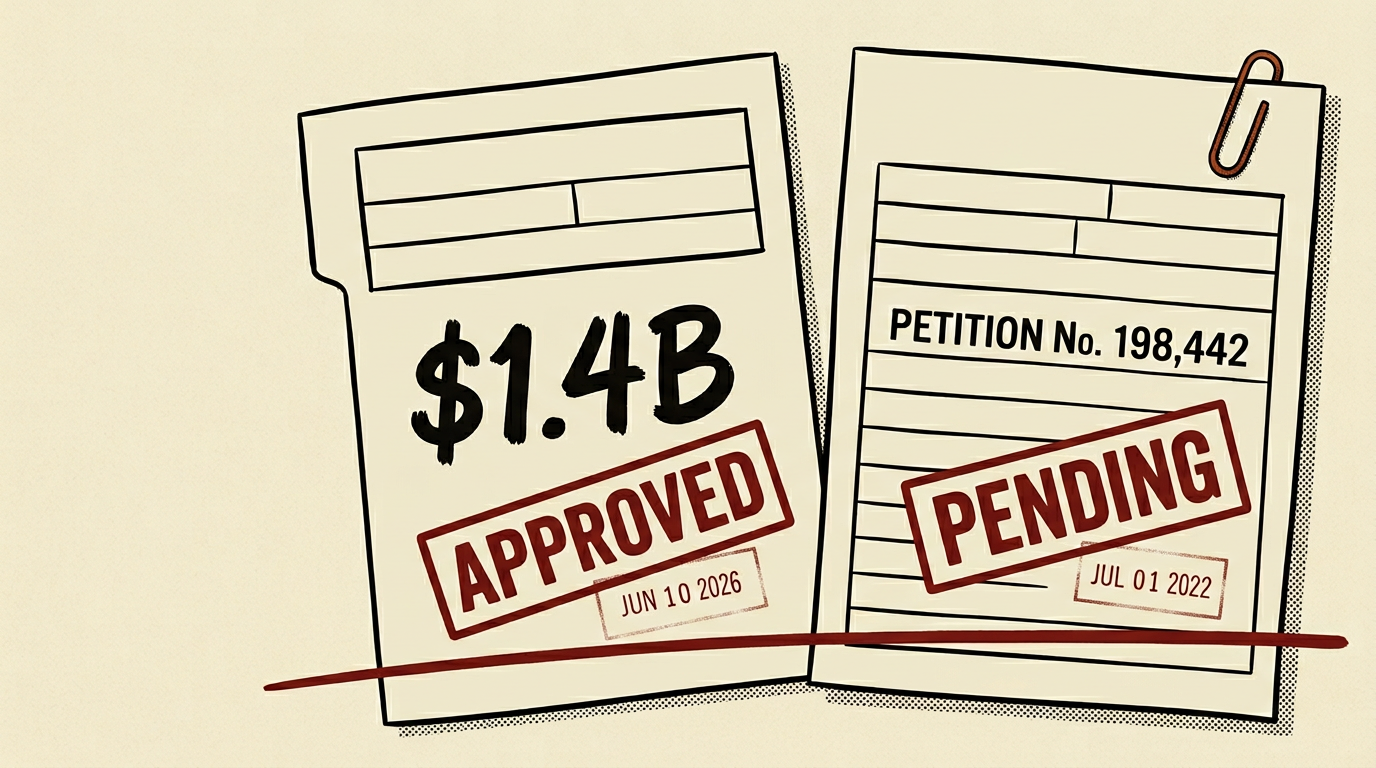
One robot company raised up to $1.4 billion on June 10. The federal program built to catch the workers it replaces has been dark since 2022.
"The future of AI will not only live on screens. It will move, interact, learn and work beside us in the real world." That was David Reger on Wednesday, June 10, the morning his company Neura Robotics announced a Series C of up to $1.4 billion. The round values the German humanoid maker at about $7 billion. On the cap table: Tether, Qualcomm, Amazon, NVIDIA, Bosch, Schaeffler, the European Investment Bank. Reger's stated goal for the company is five million robots by 2030, built for industry, services, and the home.
"Beside us" is the gentle word. The plan the money is buying is substitution. Up to $1.4 billion, raised in a single afternoon, to build machines that stand where people stand. Say "up to," because the figure is milestone-contingent. Then set it inside the year: robotics companies have pulled in about $55.8 billion in 2026 so far, nearly double the previous record. The forecasts riding shotgun are the demand signal under the checks. Goldman Sachs models more than 250,000 humanoid shipments by 2030. Morgan Stanley models 13 million humanoids in service by 2035, roughly 90% of them in repetitive industrial and commercial work.
The industry sells this as rescue. Reger points to a deficit of 101 million workers across China, Japan, and Europe by 2030: the robot as a gift to a workforce that isn't there. Hold that claim. We come back to it, because part of it is true.
First, the room that benefits, because it has names. The cap table is the room. Tether and Qualcomm and the European Investment Bank do not win if your wages rise. They win if payroll becomes a line item a spreadsheet can delete. Amazon is on that list, and Amazon already runs more than a million warehouse robots and models avoiding some 600,000 future hires. The company writing checks for the humanoid is the same company designing the door it never has to open.
Now the room that pays. Walk into the body shop at BMW's plant in Spartanburg, South Carolina. For about ten months, two Figure AI humanoids ran ten-hour shifts, Monday through Friday, moving more than 90,000 components and logging roughly 1,250 operating hours. That is a night shift a human used to work. Spartanburg is the largest BMW plant in the world: more than 11,000 direct employees, about 1,500 vehicles a day. The welder whose ten hours those were is the worker the $55.8 billion has no line for. Across the country in 2026, the layoff ledger already reads 185,894 workers across 267 events, with AI or automation named in a reported 56% of them.
And the one federal program built to retrain Americans thrown out by economic change, Trade Adjustment Assistance, has not certified a single new worker since July 1, 2022. Nearly 200,000 petitions sit frozen in a queue that cannot move. The money to build the replacement cleared in an afternoon. The money to catch the replaced has not moved in four years.
Now the honest part, because we don't strawman the other side. The demographic case is real where the people really are missing. Japan faces a care-worker gap near 570,000 by 2040. By 2030, one in six people on earth will be over 60. A robot in an understaffed eldercare ward in Nagoya is not taking a job a human wanted. But the capital is pooling fastest in the United States, which is not short of working-age people, and where 56% of this year's cuts already point at AI. The shortage story is loudest exactly where the layoffs aren't. Shawn Fain put it plainly at the UAW convention on June 16: "We are in a fight for humanity."
The alternative is not complicated, and it is not anti-robot. It is a country that funds the landing pad before the thing it funded arrives. The bills exist. Rep. Linda Sánchez filed a TAA Modernization Act in March. Sen. John Fetterman filed a reauthorization in April. A long-stalled TAA for Automation Act would, for the first time, make workers displaced by a machine eligible for help at all. Money for the machine moves at venture speed. The promise to the worker has read "pending" since 2022.
What to do this week. Call your House representative and both senators. Ask them to reauthorize Trade Adjustment Assistance and to expand it to cover workers displaced by automation. The asymmetry is not weather. It is a choice somebody made, and choices have phone numbers.
The industry already told us what it intends. You can read it in the size of the checks. The only open question is whether we build the landing pad before the thing lands. The check clears in an afternoon. The worker has been waiting since 2022.
— Stay Human ★
Get the Dispatch every Sunday.
Free. One issue a week. Forever — until you unsubscribe.