
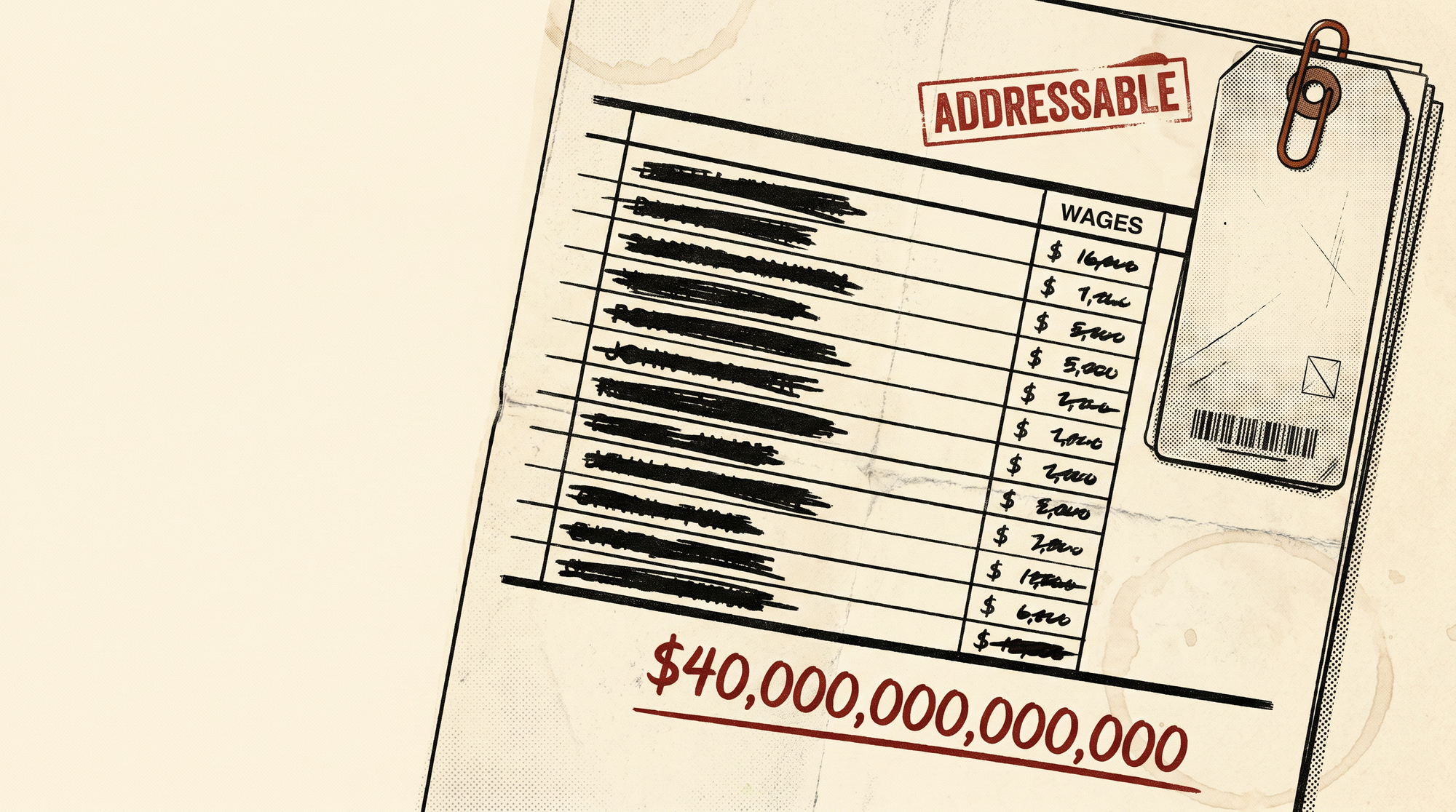
Jensen Huang keeps calling humanoid robots a $40 trillion market. He's not wrong about the number. He's just calling a payroll a market and hoping nobody checks whose.
0.
He says it the way you'd announce good weather.
All spring, Jensen Huang has stood in front of one screen after another and told the room that humanoid robots are a forty-trillion-dollar opportunity. Sometimes he says fifty. The figure drifts depending on the stage. The point doesn't. It's the biggest market anyone in tech has ever pointed at, bigger than phones, bigger than the internet, and Wall Street took the cue. By late spring, analysts were loading up on "physical AI" stocks like the number was a discovery somebody had just made.
Nobody on those calls asked the obvious thing. Forty trillion dollars of what? That money exists right now, today, before the robots ship in any real volume. So where is it?
It's in paychecks. The forty trillion isn't sitting in an open field waiting to be farmed. It's what the world already pays people to work. Huang knows that, because he's the one who ran the math. The number isn't a forecast of new wealth. It's the wage bill with a new label on it.
This is a short piece about one number, and what it means that the man selling the future said the quiet part into a live mic and got applause.
One thing before we start, because people misread the brand on purpose. This isn't an argument against AI. I use it every day, including for the research under this page. The machines aren't the enemy and intelligence isn't the threat. The threat is narrower and a lot older than that: the plan where the work that feeds a family gets reclassified as a cost, the cost gets removed, and the removal gets sold upstairs as growth. Forty trillion dollars is that plan, written in the only language a quarterly call respects. So let's read it back to them.
I. Where the Number Comes From
Give Huang this much: he doesn't hide the math. He volunteers it.
Here's roughly how he lays it out. The world economy runs north of a hundred trillion dollars a year, and a big slice of that, he's said around fifty trillion, is just human work, the stuff people do with their hands and their heads. Two and a half billion people on the planet do some kind of physical labor. Total up what they earn for it and you get, in his words, "$50-plus trillion in annual labor output waiting to be automated."
He'll even hand you the analogy. AI is going to do to the economy what motors did to labor. His comparison, not mine. When he wants it to sound kinder, he calls the robots "AI immigrants" taking the jobs we supposedly didn't want. Kind version or blunt version, the unit is the same: a task a person does now, and the money that person gets for doing it.
So when it all tightens into the forty-trillion headline for humanoids, look hard at what's in the bucket. By his own description it's a market for labor automation. Not better tools for workers. Automation. Taking the worker out as the thing that earns the money.
Now set a real figure next to his. The International Labour Organization keeps track of how much of everything the world produces actually finds its way back to the people who produced it. In 2024 that share was about 52.4 percent. A little over half of global output, paid out as wages. Against a hundred-trillion-dollar economy, that's somewhere around fifty to fifty-five trillion dollars a year in pay.
Line the two up. What the world pays its workers: roughly fifty trillion. The market Huang is aiming his whole industry at: forty to fifty trillion. Same number, because it's the same money. He didn't find a new continent. He drew a circle around the one we already live on and called it undeveloped.
That's the tell, and it's worth saying flat out before we go on. The forty trillion isn't new demand the robots are going to create. It's demand that's already met, by people, who are already paid. The robots just have to go stand where those people stand.
II. Every Other Market Is a Want. This One Is a Wage.
Every big market technology ever cracked open was, underneath, a want with no product attached to it yet. The smartphone was billions of people who wanted the world in their pocket and would pay for it. Streaming was wanting to watch anything at any hour. The internet, the comparison this industry loves, was a hunger for connection with no good way to feed it. Those markets got made. The money in them wasn't money anybody was already spending; it showed up when the product did. You added something to the world, and people paid you for the addition.
The forty-trillion-dollar robot market has no want under it. Nobody lies awake wishing they could pay a machine to stock a shelf. The shelf already gets stocked. The part at the BMW plant already gets moved, by someone who's already paid and already there. The only way a robot "captures" that forty trillion is to take the spot the worker is in and route the wage that used to be that worker's income into somebody's margin instead.
Run it as arithmetic and the whole thing is just subtraction. In a want-based market the customer's spending is new, so everyone can come out ahead at once: the buyer gets something they didn't have, the seller gets paid, and nobody had to lose a living for the sale to happen. A wage-based market doesn't work like that. The spending was already happening. We just called it payroll. To move it onto the robot's side of the ledger, it has to come off a paycheck first. Nothing got bigger. The pie is the same size it always was. What changed is who's eating.
Which is why hanging "total addressable market" on human work is such an ugly move. A TAM is supposed to measure how much of a want you can serve. Point it at labor and it measures how many people you can make unnecessary. Forty trillion is an estimate of how much employment is, in principle, up for grabs. The address in "addressable market" is somebody's job.
And look what the phrase does to the person standing in it. It deletes them. On the worker's side, that wage is rent, a kid's teeth, a tank of gas, a whole life with a name on it. On the robot-maker's slide, the same wage is a revenue line: anonymous, swappable, scrubbed clean of the human. The scrub isn't a side effect. It's the product. The pitch only lands if you see forty trillion dollars and don't see the fifty million households it's feeding right now.
III. The Number Is Already Moving
You could wave all this off as keynote theater if the number were still stuck on a slide. It isn't. The forty trillion has started to move, and you can follow it off the screen and into the world one receipt at a time.
Start on the factory floor. Figure, one of the better-funded American humanoid outfits, says its new line builds a robot about once an hour, in a plant tooled for twelve thousand a year. Its last model spent eleven months at a BMW plant in South Carolina, where, the company says, it worked ten-hour shifts, logged twelve hundred hours, and moved ninety thousand parts. Sit with that vocabulary a second. Hours logged. Parts moved. Shifts worked. That's not how you talk about a tool. That's how you talk about an employee, on a timesheet, up for review. They're measuring the robot in the same units they measure the person next to it, because that's how the buyer is going to decide which of the two to keep.
Go up to where the number gets priced. In June, Unitree, the Chinese company that's become the world's biggest humanoid seller, cleared its review to list in Shanghai, the first "embodied AI" company onto China's main board. Its prospectus shows revenue up more than three hundred percent in a year and profit up nearly seven hundred. You don't get a curve like that selling novelties. You get it when the thing you sell is worth tearing out an existing cost for, and for most operations the priciest cost on the books is people. The IPO is the forty-trillion thesis filed with regulators: buy in, because what we make replaces something expensive, at scale, soon.
Then there's the company already farthest down the road. Amazon runs more than a million robots now, a count creeping up on its human headcount, and planning documents reported last year describe a goal of automating most of its operations and skipping hundreds of thousands of future hires. That's the forty trillion in its natural habitat. Not a market a salesman is chasing. A line item an operator is quietly retiring, one robot and one un-posted job at a time.
Every so often somebody just says it, so you don't have to read between anything. This month a facilities-services firm announced it was running humanoids through its buildings to "optimize labor efficiency" and "expand operating margins." Peel off the press-release varnish and it's Huang's stage line, just lower to the ground. The labor getting optimized is a person. The margin getting expanded is the gap between what that person earned and what the machine costs.
None of it needs the robots to be good at everything. It needs them good enough at one well-paid, repetitive job to tip a buyer who'd rather own a depreciating asset than keep paying a human. The number doesn't need a miracle. It needs a spreadsheet, and the spreadsheets are already open.
IV. What the Number Doesn't Price
So is it inevitable? That's the feeling the number is built to give you. Forty trillion dollars of gravity, dragging everything toward one ending. Be honest about the part that's real. Then be just as honest about the part the slide leaves off.
The real part: the incentive is huge, and it isn't going anywhere. Turn a recurring wage into a one-time purchase and you've got about the strongest pull there is in business. It's why the layoff trackers keep climbing, past a hundred and fifty thousand tech jobs cut this year, with most of the announcements naming AI or automation. Some of that is real substitution. Anybody who tells you the number is harmless is selling something too.
Here's what forty trillion dollars can't put a price on.
It can't price the fact that a wage doesn't just vanish when you cut it. The same paycheck is a cost to the company and income to a household and demand in the economy, all at once. It buys the products the automation is supposed to sell. Delete fifty million of them and the customers go too. A spreadsheet reads payroll as pure drag. The economy reads it as blood moving. You can model the first and ignore the second, which is how you end up bullish on selling to a public you're busy making broke.
It can't price the people who decline to be addressable. The same season Huang named his number, those people turned up in the record. The Senate voted 99 to 1 to strip a sweeping cap on state AI laws out of a federal bill. Forty-two state attorneys general turned around and subpoenaed OpenAI. Seattle, the original company town of the cloud, voted 9 to 0 to pause the buildout that powers these systems, with its own engineers testifying for the pause. Gallup found 71 percent of Americans don't want this stuff built near them. None of that fits in a TAM. A market sizing assumes want slides frictionlessly into purchase. It has no cell for no.
And it can't price dignity, which is the variable the whole thing secretly runs on. The forty trillion holds only as long as fifty million households agree to see themselves the way the slide sees them: as cost, as inefficiency, as margin waiting to get expanded. The day they see themselves as what they actually are, the people who do the work and vote and organize and buy the products, the spreadsheet's load-bearing assumption cracks.
This is hope, not faith. The friction is winning votes, not wars. The incentive is still the biggest thing in the room, and one boardroom or one act of Congress can roll back a lot of 9-to-0s. But a number this size has a tell of its own. You don't keep announcing that something is inevitable when it actually is. The volume is the giveaway. They're telling you it's already decided because the one thing that could undecide it is you noticing it isn't.
V. The Name They Removed
Go back to the keynote, and this time stand in the right spot.
When Huang says forty trillion dollars, everybody in that room hears a market. Opportunity. Upside. A wave to get out in front of. Almost nobody hears the other thing in the sentence, which is us. The cashier, the picker, the line cook, the parts-mover, the night custodian, the home health aide. The forty trillion isn't floating above the workforce. It is the workforce, added up and stripped of names so it can be shown to investors as something cleaner than a plan to replace people.
That's the trick, start to finish. Take the wage. Pull the worker off it. Call the worker's absence "efficiency" and the worker's wage "addressable market." Hand the result to a room that will cheer the size of it precisely because the names are gone, because forty trillion dollars is a thrilling number and fifty million displaced households is a moral problem, and the entire job of the phrasing is to let you feel the first and never see the second.
So put the names back. That's the only real work here, and it's the exact work the number is designed to stop. Every dollar of that forty trillion has a person on the far end of it, doing something real, for money they live on. It's a payroll wearing a market's clothes. The headcount in the title isn't a figure of speech. It's the literal contents of the number: heads, counted, then wiped off the slide so the slide would sell.
They keep telling us it's inevitable. They say it loud, in dollars with a lot of zeros, because the number is supposed to win the argument for them. But a market that can only grow by subtracting the people it's measured from isn't value being discovered. It's a transfer dressed up as a discovery, and a transfer can be refused.
Forty trillion dollars is just the wage bill with the names peeled off.
Put yours back on.
— Stay Human ★
Sources & notes
- Huang's $40–50T framing: Yahoo Finance — "65% of world GDP / $50T... motors replaced labor"; Nasdaq — "$50-plus trillion in annual labor output"; Tom's Hardware — "AI immigrants"; 24/7 Wall St — $40T "labor automation" TAM. Figures shift $40T/$50T by venue; the essay flags this.
- Global labour share ~52.4% of GDP (2024): ILO — Global Labour Income Share and Distribution. World GDP ~$100–110T (IMF).
- Figure production / BMW: eWeek. Company-reported throughput and parts figures.
- Unitree IPO: Rest of World. Revenue/profit growth is from the prospectus, company-reported.
- Amazon robots/headcount and hiring-avoidance plan: 24/7 Wall St; Futurism (on reported internal documents).
- YY Group deployment language: PR Newswire, 2026-06-09.
- Layoffs / AI attribution: Yahoo Finance — 2026 tech layoffs near 150,000. Trackers disagree on totals.
- Friction receipts: Roll Call — Senate 99-1 / Great American AI Act; Tom's Hardware — 42-state AG subpoena; Seattle City Council 9-0; Gallup 71%.
Get the Dispatch every Sunday.
Free. One issue a week. Forever — until you unsubscribe.